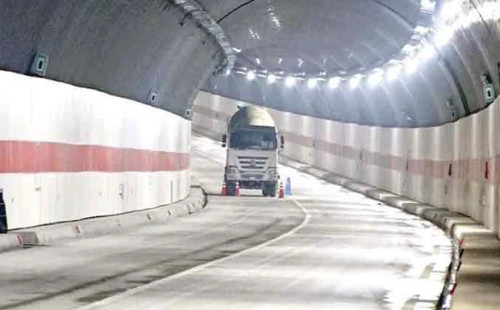
Tk10,689cr Karnaphuli Tunnel struggling to close revenue gap amid thin traffic: IMED
Highlight
- Tunnel
traffic only 14% of projected 2025 daily vehicle target.
- Low
traffic causes average daily revenue loss of Tk10 lakh.
- Higher
tolls alone cannot close revenue gap, IMED finds.
- Operating
costs exceed toll income, creating persistent annual financial deficits.
- Project
cost increased 26.56% from original revised estimate.
- IMED
recommends industrial growth and integrated transport to boost tunnel
usage.
The under-river Karnaphuli Tunnel faces growing financial
pressure as traffic volumes remain far below initial projections, making it
impossible to close the revenue gap through toll increases alone, according to
an impact assessment report by the Implementation Monitoring and Evaluation
Division (IMED).
The government watchdog's assessment, published
on Tuesday (30 June), found that the level of demand needed to significantly
increase tunnel use is unrealistic based on an analysis of the "price
elasticity of demand".
According to the project's feasibility study, an
average of around 28,350 vehicles were expected to use the tunnel every day in
2025.
However, current traffic is only around 4,000 to
4,500 vehicles daily – about 14% of the forecasted level.
This leaves the tunnel facing an 86% demand
shortfall, resulting in an average daily revenue loss of around Tk10 lakh, the
report said.
The IMED noted that raising toll rates would not
be an effective way to address the gap.
The report found that if the toll is doubled
from Tk100 to Tk200, demand elasticity would stand at negative 2.82, which it
described as highly unusual.
Even with a 50% increase in tolls to Tk150, the
elasticity would become negative 4.83 – a level considered impractical.
According to global standards, demand elasticity
for private cars generally ranges between -0.3 and -0.6, while for trucks it
ranges between -0.1 and -0.4.
The report said the elasticity needed to make
the Karnaphuli Tunnel financially viable is around 10 to 20 times higher than
normal levels, which is practically impossible to achieve.
It further noted that demand for the tunnel
remains highly inelastic, particularly among truck operators who continue to
avoid it due to alternative routes.
The report recommended an integrated transport
plan, better management of alternative routes and measures to encourage freight
vehicles to use the tunnel. It said ensuring financial sustainability would
require increasing traffic demand rather than depending solely on toll
adjustments.
Cost rises 26%, revenue below projections
The IMED assessment also highlighted that the
estimated cost of the tunnel increased from Tk8,446.63 crore to Tk10,689 crore
after the second revision, marking a 26.56% rise in expenditure. The project
financing includes a Chinese government loan of Tk6,077.58 crore and Bangladesh
government funding of Tk4,612.12 crore.
The feasibility study projected profitable toll
revenue based on daily traffic of 17,375 vehicles. However, actual traffic
remains far below that level.
Daily toll collection is now around Tk12 lakh,
while operation and maintenance costs are about Tk22 lakh, creating an average
daily deficit of nearly Tk10 lakh, or around Tk36.5 crore annually.
The analysis found that annual net cash flow
remains negative, meaning the investment cost cannot be recovered within the
expected timeframe.
However, the report said the financial
assessment was based on only three years of operation, which is insufficient
for a large infrastructure project. Such projects usually require long-term
evaluations over 20 to 30 years, considering future traffic growth, toll
adjustments and wider economic benefits.
It said that if traffic and revenue increase in
the future, the project's Economic Internal Rate of Return (EIRR) could become
positive by 2043 or 2053.
But, under the current situation, toll revenue
can cover only 54% to 55% of operating expenses, putting the tunnel's financial
sustainability at risk.
High maintenance costs, electricity and electromechanical
operations, loan interest payments and a lack of supporting infrastructure have
contributed to the losses.
Although the government continues to provide
subsidies due to the tunnel's strategic importance, the report warned that this
could create long-term pressure on the national budget.
The report also noted that the tunnel is
generating important non-financial benefits. More than 4,000 vehicles use the
tunnel daily, saving between 1.5 and two hours of travel time. The financial
value of this time saving is estimated at Tk18 lakh to Tk25 lakh per day.
It added that urban expansion has accelerated in
the Anwara area, while rising tourist visits to Patenga and Parki beaches have
boosted the local economy.
Integrated approach needed
The IMED report recommended coordinated
planning, faster industrial development and improvements in the transport
system to unlock the tunnel's potential.
It said the government needs to accelerate
port-based industrial development on the Anwara side and improve coordination
among agencies involved in developing industrial zones, including Karnaphuli
Dry Dock, China EPZ and Korean EPZ.
The report stressed the importance of
implementing the "one city, two towns" concept effectively. It said
integrated land-use planning, modern urban development and the creation of
commercial and logistics hubs on both sides of the tunnel could increase usage.
It also recommended expanding cargo handling
activities at the Anwara side of Chattogram Port and improving road
connectivity with the Matarbari deep-sea port.
Although the tunnel is facing financial
challenges due to lower-than-expected traffic and an imbalance between income
and expenditure, the report said the situation could improve through policy
measures, industrial expansion and coordinated infrastructure development