Global aviation giants eye Bangladesh's airport transformation
Bangladesh's aviation sector has reached a significant
milestone as five of the world's leading airport service providers compete to
operate at Hazrat Shahjalal International Airport's (HSIA) Third Terminal,
reflecting growing global confidence in the country's ambition to emerge as a
regional aviation hub.
For the first time since
Bangladesh's independence, internationally renowned airport service companies
are seeking entry into the country's ground handling market following the Civil
Aviation Authority of Bangladesh's (CAAB) decision to appoint a second passenger
ground handling operator at the Third Terminal.
A senior CAAB official involved in
the negotiations confirmed to BSS here recently that a second operator would be
appointed for passenger-related ground services, while cargo handling at the
new terminal would remain exclusively under Biman Bangladesh Airlines.
"The second handler will be limited to passenger and ground handling
activities. Cargo handling will remain solely with Biman," the official
said.
Industry experts viewed the
development as a strong endorsement of Bangladesh's expanding aviation
industry, driven by sustained passenger growth, major infrastructure
investments and increasing international connectivity.
Among the contenders are- UK-based
Menzies Aviation, Switzerland's Swissport, Türkiye's Çelebi Aviation Holding,
UAE-based data, part of the Emirates Group, and Singapore's SATS, all globally
recognised airport service providers.
Former CAAB Chairman Air
Vice-Marshal (retd.) Muhammad Mafidur Rahman said Bangladesh had rarely
attracted simultaneous interest from so many international aviation companies,
highlighting the country's growing strategic importance in South Asian
aviation.
Diplomatic interest underscores
confidence
Over recent months, ambassadors
from the United Kingdom, Switzerland, Türkiye and the United Arab Emirates have
separately discussed their respective companies' interests with Bangladesh's
aviation leadership.
"Such diplomatic engagement
reflects the commercial importance attached to Bangladesh's expanding aviation
market and the confidence international investors have in the country's
long-term growth prospects," Rahman said.
A landmark reform
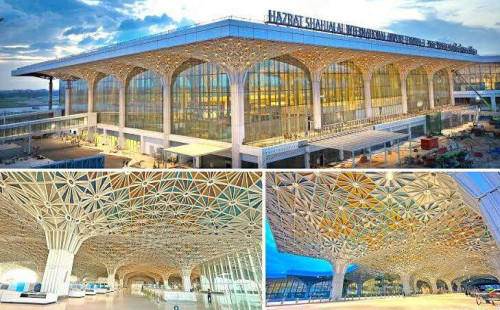
The Third Terminal represents a
major policy shift as it introduces competition in passenger ground handling
after decades of Biman Bangladesh Airlines' exclusive responsibility.
Ground handling includes aircraft
servicing, baggage management, passenger check-in, ramp operations and aircraft
turnaround services that directly influence operational efficiency and
passenger experience.
Foreign airlines have long
advocated greater competition, arguing that it would improve service quality,
reduce turnaround times and align Bangladesh with international standards.
Managing Director of Novoair and
Secretary General of the Airline Operators Association of Bangladesh (AOAB)
Mofizur Rahman welcomed the decision.
"I think the issue deserves
careful consideration, even if it is addressed at a later stage. For now,
however, I am happy that competition is at least being introduced in passenger
handling services," he said.
Noted aviation entrepreneur and
Chairman of TAS Aviation Group K M Mozibul Hoque also described the global
interest as a positive sign.
"Cargo villages and ground
handling operations both should be managed by internationally experienced
operators," he said.
"Ownership may remain with the
government, but operations should be entrusted to proven global companies.
Professional operators can improve efficiency, safety, compliance and service
quality while transferring knowledge to local manpower," he added.
While welcoming competition in
passenger handling, industry stakeholders questioned the decision to retain
Biman as the sole cargo handler at the Third Terminal's automated Cargo Village.
"There are sufficient
questions about whether Biman's cargo handling is up to international
standards. There are serious concerns regarding both capability and
integrity," Mofizur Rahman said.
Former CAAB Chairman Mafidur Rahman
also suggested that international expertise could help maximise the benefits of
the terminal's advanced cargo systems.
"The equipment installed is
state-of-the-art and requires experienced operators," he said.
"It would have been better if
an experienced international operator had worked alongside Biman initially so
that knowledge could be transferred before moving to a fully local
operation."
However, he remained optimistic,
saying: "There is nothing to be disappointed about it. If expert
professionals are utilised properly, the aviation sector will gain new
dynamism."
Biman expresses confidence
General Manager (Public Relations)
Boshra Islam told BSS that Biman has already procured the required ground
handling equipment and recruited more than 1,000 additional personnel for the
Third Terminal.
"We are ready to conduct
passenger and cargo handling operations at the Third Terminal," she said.
She added that Biman is working
with the Japanese consortium on cargo handling arrangements and has not yet
received any official communication regarding the appointment of a second
passenger ground handler.
A Japanese consortium comprising
Japan Airport Terminal Company, Sumitomo Corporation, Nippon Koei and Narita
International Airport Corporation is set to assume operation and maintenance
responsibilities for HSIA's Third Terminal after the signing of the final
agreement.