PM calls for withdrawal of black money legalisation provision in proposed budget
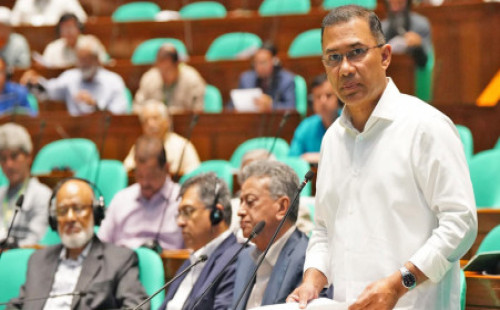
Prime Minister Tarique Rahman today (29 June) called for
the withdrawal of the provision in the proposed budget for the 2026-27 fiscal
year that would allow undisclosed money to be legalised, saying the measure had
drawn public criticism.
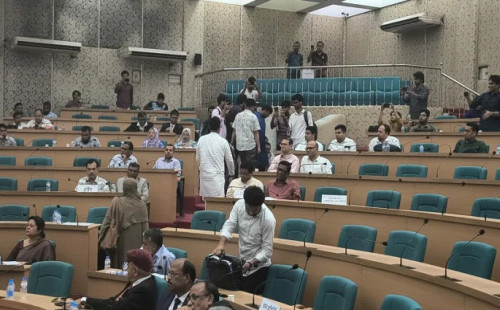
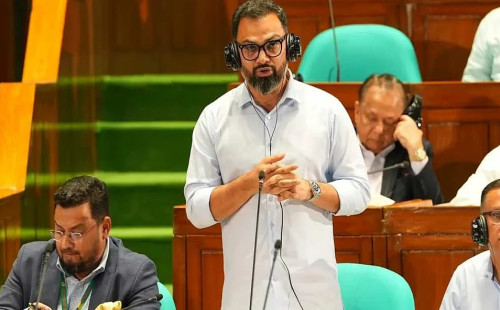
Participating in the general
discussion on the proposed budget in the National Parliament, the prime
minister urged the finance and planning minister to remove the provision.
He also placed a series of
proposals relating to taxation, tariffs and investment incentives.
Among the proposals were raising the tax-free income threshold for individual
taxpayers, withdrawing the requirement for a Taxpayer Identification Number
(TIN) to open bank accounts and register property, and reducing the tax rate
for private universities.
The prime minister also proposed
expanding tax-free facilities for ethnic minority communities.
In addition, he called for reducing
tariffs and taxes on the import of raw materials used in the shrimp sector,
manufacturing industries and other local industries.
Tax-free income limit, TIN requirements
The prime minister said the proposed budget set the tax-free income threshold
at Tk375,000 for the 2026-27 and 2027-28 assessment years, Tk400,000 for the
2028-29 and 2029-30 assessment years, and Tk450,000 for the 2030-31 assessment
year.
However, he proposed raising the
limits further to Tk400,000 for the 2026-27 and 2027-28 assessment years,
Tk450,000 for the 2028-29 and 2029-30 assessment years, and Tk500,000 for the
2030-31 assessment year.
Explaining the rationale behind the
proposed black money legalisation provision, the prime minister said it had
been included to reduce difficulties faced by taxpayers when declaring the
actual purchase price of land.
He noted that land is often
registered at mouza rates rather than actual market values, creating complications
for taxpayers seeking to disclose the true purchase price.
However, he said feedback from the
media, social media, members of parliament and other stakeholders indicated
that many people viewed the provision as an opportunity to legalise undisclosed
money.
Respecting public opinion, he urged
the finance and planning minister to withdraw the proposal.
The prime minister also said the
proposed budget sought to make TIN submission mandatory for opening bank
accounts, except in a few cases including students, as well as for registering
partition deeds and completing property mutation.
Noting public concern and confusion
over the measures, he called for both proposals to be withdrawn.
Private universities, ethnic minorities
To support higher education, the
prime minister proposed reducing the tax rate for private universities from the
current 10% to 5%.
He said universities receiving the
benefit should strengthen research and development activities, establish
language-learning laboratories to help students become proficient in multiple
languages, and expand opportunities for poor and meritorious students to study
without tuition fees.
He also proposed expanding tax
benefits for ethnic minority communities.
At present, the proposed budget
includes tax exemptions on certain incomes of ethnic minorities living in the
hill districts.
Tarique said the exemption should
be broadened to cover business, agricultural and salary income of all ethnic
minority communities in both hill and plain areas.
He noted that ethnic minority
communities also live in districts including Dinajpur, Mymensingh and
Netrokona, and therefore the benefit should not be limited to the hill regions.
Support for shrimp and manufacturing industries
The prime minister called for the
complete withdrawal of import duty, regulatory duty, supplementary duty and VAT
on aqua feed, feed additives, probiotics, vitamins, minerals and necessary
machinery used in the export-oriented shrimp sector.
According to him, such measures
would improve the competitiveness of the country's shrimp industry and help
increase exports.
He also proposed additional
concessional facilities for manufacturing industries importing raw materials.
Noting that honey is used as a raw
material in several industries, including pharmaceuticals, he called for the
withdrawal of the existing 10% supplementary duty on honey imports.
He further proposed reducing the
planned 10% import duty on PVC and PET resin to 5%.
In addition, he recommended the
withdrawal of the 10% regulatory duty on cold rolled sheets used in fire door
manufacturing, the regulatory duty on flat rolled plated or chromium
oxide-coated products used in manufacturing industries, and the associated
advance tax.
To support the electric wire manufacturing
sector, he called for the complete withdrawal of the 10% regulatory duty on
refined copper imports. He also proposed reducing the planned 15% customs duty
on crude cashew nut imports to 5%.
The prime minister further proposed
extending the existing concessional import facility for raw materials used by
LED lamp manufacturers until 30 June 2030. He said the same facility should be
maintained for prefabricated building manufacturers until the same date.
Startups, digital economy and VAT reforms
The prime minister described the
proposed Tk500 crore fund for startups and freelancers as a landmark
initiative.
He said it was the first fund of
its kind in the country's history and would help create new entrepreneurs while
generating employment opportunities for young people through successful
startups.
To encourage the digital economy,
he proposed reducing the existing 15% VAT on advertising through social media
platforms, OTT services, search engines, online marketplaces and other digital
media to 5%.
He said the current VAT rate
encourages some businesses to make payments through informal channels rather
than the banking system, resulting in revenue losses and reduced transparency.
The prime minister also urged
consideration of additional measures to create a more business-friendly VAT
structure.
He proposed reviewing existing VAT
and tax rates on gold, gold ornaments, platinum, diamonds and silver ornaments
and drew the finance minister's attention to the issue.
He further called for a full
exemption from the 15% VAT imposed on revenue-sharing payments to the
Bangladesh Telecommunication Regulatory Commission (BTRC).
In addition, he proposed
withdrawing the 10% VAT imposed at the supplier level on the supply of all
types of fish.
Governance, judiciary and administrative reform
The prime minister called for
reducing the existing 15% VAT to 5% on the local production of double-cabin
pickups and microbuses to support the domestic automobile industry.
He also proposed easing the
mandatory submission of coefficients in certain cases to make compliance with
the standard VAT rate easier.
Concluding his speech, he said the
true strength of a state lies not only in its wealth but also in good
governance, justice, accountability and public trust.
Alongside economic reforms,
establishing good governance at every level of the state is essential for
sustainable development, he said.
Highlighting the importance of
judicial independence in ensuring democracy, the rule of law and human rights,
the prime minister said he had requested an additional Tk100 crore allocation
for the Supreme Court and Tk500 crore for the Ministry of Law to address
judges' housing shortages, support research activities and improve court
infrastructure.
He also stressed the need to
improve efficiency in public administration, saying that accountability, a
proper salary structure, modern training and a work environment free from
political interference are necessary to deliver better public services.
Tarique said the government was not
seeking to hide the country's problems. He noted that the economy had been
affected by corruption, irregularities and economic mismanagement over the past
one and a half decades, and said the government was working to overcome those
challenges and meet public expectations.
He added that Bangladesh's people
are industrious, its youth talented, its farmers productive, its expatriates
patriotic and its entrepreneurs full of potential, expressing confidence in the
country's ability to recover.
Call for unity and democratic commitment
Calling on all members of
parliament, the prime minister said the budget should be viewed not simply as
the government's budget but as a budget for rebuilding the nation.
He said he agreed with remarks made
by the leader of the opposition and stressed that, despite political
differences, all sides should work together to restore economic stability, ease
public hardship, bring discipline to the financial sector, rebuild investor
confidence, create opportunities for farmers, youth, women, expatriates and
entrepreneurs, and strengthen democratic institutions.
He said it should be a collective
commitment that fascism or autocracy would never again take root in the country
and that Bangladesh would never become a subservient state.
Describing budget preparation as a
demanding task, the prime minister thanked the finance and planning minister as
well as officials and employees of the Finance Division, National Board of
Revenue, Economic Relations Division, Financial Institutions Division, Ministry
of Planning, Bangladesh Bank and other relevant ministries and divisions for
their contributions.
He also expressed gratitude to the
National Parliament Secretariat, BG Press and media personnel covering the
budget session for their support in the budget preparation and parliamentary
process.
Future reforms
The prime minister said public
expectations in "post-fascist Bangladesh" are now very high. People
elected members of parliament to establish democracy, human rights, the rule of
law, justice and good governance, he said.
He noted that many political
leaders and activists had sacrificed their lives, suffered injuries, faced
cases and attacks, and lost everything in the struggle for democracy.
Reflecting on his own experience,
he said that after spending a long period abroad, he found that many of his
fellow political colleagues were no longer alive when he returned. He added
that many veteran opposition leaders were also no longer alive. Paying tribute
to sacrifices on all sides, he said the best way to honour them was through
responsible politics.
Tarique said that, with the July
Charter as a guiding framework, consensus could be built both inside and
outside parliament on national issues, including constitutional reform. He
urged political parties to work together to build public opinion on important
national matters and pursue reform programmes responsibly.
Addressing the nation, he said the
current government and parliament belong to the people. The government, he
said, gives the highest priority to public aspirations, understands people's
hardships and regards protecting public wealth as a sacred responsibility.
He said the government aims to
build a Bangladesh where development is based on justice, the economy is
inclusive, the state is accountable and every citizen can live a safe,
dignified and prosperous life.
The prime minister concluded by
thanking the speaker for the opportunity to address the budget session and
reiterated his call for collective efforts to advance the country's welfare.