One year after Milestone tragedy, grieving families await justice as key safety reforms remain stalled
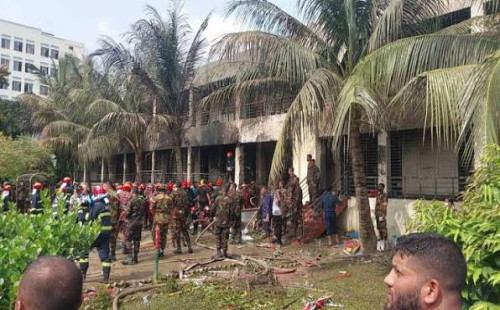
One year after the Bangladesh Air Force
training aircraft crashed into Milestone School and College in Uttara, killing
35 people, grieving families are still waiting for justice, survivors continue
to battle life-changing injuries, and many of the safety reforms recommended by
the official investigation remain unimplemented.
Prayers and remembrance programmes are
being held today (21 July) to mark the first anniversary of one of the
country's deadliest aviation disasters.
But for many of the victims' families,
the pain has been compounded by what they describe as a lack of accountability
and slow progress in addressing the systemic failures that led to the tragedy.
The accident occurred on 21 July 2025 when a Bangladesh Air Force FT-7 BGI
training aircraft lost altitude during its second circuit and crashed into the
Haider Ali building of Milestone School and College.
The crash triggered a massive explosion
and fire, killing students, teachers, guardians and the pilot, Flight
Lieutenant Towkir Islam.
Investigation exposed systemic failures
The official probe concluded that the
disaster was not solely the result of an aircraft accident but also reflected
deep-rooted failures in urban planning, regulatory oversight, aviation safety
and building compliance.
The commission proposed more than 30 recommendations aimed at preventing
similar incidents, including stricter enforcement of airport safety
regulations, relocating military flight training outside Dhaka and gradually
moving educational institutions away from airport approach zones.
However, documents reviewed by The
Business Standard show that many of those recommendations remain unimplemented
a year later.
Airport safety concerns remain
Milestone's Diabari campus lies within
the airport's Obstacle Limitation Surface (OLS), a protected airspace where
both building height and land use are subject to restrictions to ensure flight
safety.
According to Civil Aviation Authority of
Bangladesh (CAAB) documents, the campus is located within the airport's Inner
Horizontal Surface and Inner Approach area, where buildings are not permitted
to exceed 150 feet.
Despite those restrictions, Milestone
School applied to Rajuk this month for permission to construct another
seven-storey academic building on its campus.
Construction of another previously
approved 10-storey building is already underway.
When asked about implementation of the
commission's recommendations, CAAB Chairman Air Vice Marshal Md Mostafa Mahmud
Siddique referred The Business Standard to CAAB Member (Air Traffic Management)
Air Commodore Md Nur-e-Alam.
Nur-e-Alam said CAAB had formally
informed Rajuk about buildings exceeding permissible height limits around the
airport.
"Over the past year, Rajuk, CAAB
and other relevant agencies have been jointly reviewing these buildings.
Additional personnel have recently been assigned to support the review process.
However, Rajuk will be able to provide information on how many buildings have
faced enforcement action," he said.
The investigation report also found that
between 2015 and 2025, CAAB repeatedly warned Rajuk about 630 buildings
violating airport height restrictions, but investigators found no evidence of
effective enforcement.
Professor Adilur Rahman Khan, executive
director of the Institute for Planning and Development (IPD), said permitting
further construction in an area already identified as high-risk contradicts the
investigation's findings.
"Following such disasters, authorities
often become active for a while, but implementation eventually stalls," he
said.
Families still seeking justice
Following the crash, the interim
government announced compensation of Tk20 lakh for each deceased victim's
family and Tk5 lakh for each injured survivor.
Many affected families rejected the
offer.
Instead, the investigation commission
recommended Tk1 crore in compensation for the family of each deceased child and
Tk80 lakh for each deceased adult, alongside substantially higher financial assistance
for burn victims requiring long-term treatment.
A member of the investigation
commission, speaking on condition of anonymity, said no amount of compensation
could erase the trauma suffered by victims' families, adding that successive
governments had failed to implement the commission's recommendations.
Habibur Rahman, whose seventh-grade son
Jabir Farhan died in the crash, said the victims' concerns have yet to receive
an adequate response.
"I heard Milestone plans to build
another building," he said. "Why does the administration not stop
this? Schools should be relocated from this area before another tragedy
happens."
For many families, the first anniversary
serves not only as a day of mourning but also as a reminder that the questions
raised by the disaster remain unanswered, and that the reforms intended to
prevent another tragedy are still largely confined to paper.