Sacrificing a forest to 'save' a city: A waste transfer station at the heart of Bhawal National Park
On the outskirts of the Dhaka–Mymensingh highway sits Bhawal
National Park, a reserve forest that is meant to function as Dhaka's lungs —
one of the last Sal forests left standing in the country.
Along the highway, household waste has
accumulated for years beside the edge of the forest. The toxic dumps at the
outskirts of the road and Bhawal's forest sit side by side, creating an uneasy
contrast.
But right in the middle of Bhawal National
Park's boundary, a more disturbing scene appears.
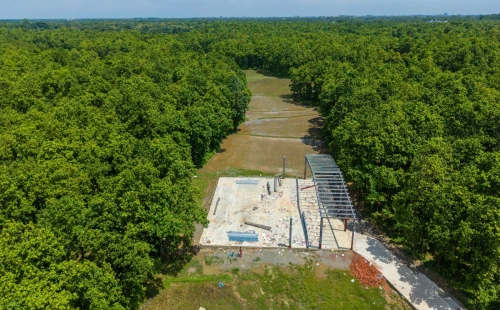
A section of the boundary is broken. A road
leads in from there, to a half-built infrastructure — a waste transfer station,
standing in the middle of the reserve forest. A signboard promoting the
government's "5 Crore Tree Plantation Programme" still hangs beside
it.
The station is being built by the Gazipur City
Corporation, which it presents as a solution to the city's waste management
problem.
Bhawal National Park is spread across roughly
5,022 hectares of Sal forest in Gazipur, one of the last such stretches left so
close to the capital. Deer, wild boar, mongooses, and several species of birds
and reptiles call this forest home.
And for many of them, there is almost nowhere
else nearby left to go. The forest also serves as an important groundwater
recharge area and carbon sink for the rapidly urbanising Gazipur-Dhaka
corridor.
The forest department's paper trail
Letters exchanged between Bhawal's forest
officials and the city administration, reviewed by this correspondent, tell a
story that began long before any court got involved.
In March last year, a Gazipur City Corporation
dump truck was caught unloading waste inside the forest. A responsible official
gave a written pledge that it would not happen again. Needless to say, it did.
On the afternoon of 11 April this year, a group
of labourers appeared beside the park's boundary wall, working for a contractor
named Bishwajit Enterprise. They had been hired by Gazipur City Corporation,
according to the letters. When the range officer asked for permits, they could
not produce one. They kept working anyway.
The following night, according to the letters,
workers used an excavator to breach the park's boundary wall and filled the
opening with soil. The next day, when forest officials tried to stop the work,
somewhere between 150 and 200 labourers and politically affiliated people
gathered at the site — enough, the letters suggest, to make any attempt to halt
the construction impossible. A joint inspection days later would also find that
a portion of the reserve forest had been set on fire.
The letters state plainly that no environmental
clearance, and no site clearance, was ever sought for this project, neither
from the Department of Environment, nor from the Forest Department.
By 16 April, and again on 20 April, the
Divisional Forest Officer had escalated the matter in writing — first to the
Gazipur District Administrator, then further up the chain, to the Chief
Conservator of Forests, the police, and others. The letters cite the Forest
Act, 1927, and the Wildlife (Protection and Safety) Act, 2026, and state that
what was happening inside Bhawal amounted to a punishable offence.
It did not stop. Today, the structure stands
almost complete — a labourer at the site told this correspondent it is expected
to be finished within a week. At roughly 7,000 square feet and 25 feet tall, it
could theoretically hold nearly 2,000 tonnes of waste if filled to
capacity.
The land is being claimed as private, but legal restrictions were
issued on its use — so there is no legal loophole as such. Law is a tool, but
common sense is most important. Even if the land isn't notified as forest land,
can you construct a waste station within a National Park's boundary? Legal
minds would never have imagined, even in their wildest dreams, that a
government could think of doing this.
Syeda Rizwana Hasan,
chief executive, Bangladesh Environmental Lawyers Association, and former
Environment Adviser
The legal dispute
Inside the boundary of the park, there are
certain pieces of land (jot) that are privately owned. These lands are used for
cultivation, or other practices by the owners that do not harm the forest in
any way.
But as these lands sit inside the forest's
boundary, there is little the owners are legally allowed to do with them —
government policy has, for years, restricted such enclaves to agricultural use
alone.
It was one such plot that Gazipur City
Corporation would eventually build its waste dumping station on.
By early May, Bangladesh Environmental Lawyers
Association (BELA) had taken the matter to the High Court. Its writ petition
named the government, the Ministry of Environment, the Forest Department, and
Gazipur City Corporation among the respondents, arguing that the construction
and repeated dumping inside Bhawal violated the Forest Act, 1927, and the
Wildlife (Protection and Safety) Act, 2026.
On 4 May, the High Court agreed there was a case
to answer. It restrained Gazipur City Corporation and its contractor from any
further construction — sheds, roads, tube wells — across three specific plots
inside the park, and barred all further dumping in or around Bhawal, for six
months. Two of the three plots were part of the reserve forest. The third was
the privately owned jot.
Syeda Rizwana Hasan, chief executive of BELA and
an advocate at the Supreme Court, does not accept that the private ownership of
that third plot changes much.
"The prevailing legal regime, including
recently enacted laws, is sufficient to avert a case like this," said
Hasan, who also served as the Environment Adviser to the interim
government.
"The land is being claimed as private, but
legal restrictions were issued on its use — so there is no legal loophole as
such. Law is a tool, but common sense is most important. Even if the land isn't
notified as forest land, can you construct a waste station within a National
Park's boundary? Legal minds would never have imagined, even in their wildest
dreams, that a government could think of doing this."
Gazipur City Corporation views it differently.
The corporation has struggled to manage the
waste dumped along the outskirts of the road for years.
"Where are we supposed to take the garbage?
Garbage lying on the roads is also very harmful for the environment," said
Tanjila Khanam, CEO of Gazipur City Corporation.
When asked why this station could not have been
built elsewhere, away from the reserve forest and the park, she said, "We
can't find land. We want to build several secondary waste transfer station
(STS) sites, but we can't get land. We want acres for waste management, but we
can't get it. Nobody wants to give us land."
But whether building a waste station inside the
very boundary meant to protect the forest is prudent is a separate question
altogether.
A signboard promoting the government's ‘5 Crore Tree Plantation
Programme’ hangs beside the road leading to the waste transfer station.
The ecological cost
What happens once the station is operating is,
for now, still open to speculation. But MKM Iqbal Hossain Chowdhury, Divisional
Forest Officer for Bhawal's Wildlife Management and Nature Conservation
Division, has already outlined what he expects.
"If waste is continuously dumped inside
Bhawal National Park — from industrial establishments, pathology and hospital
waste, household garbage, rotten eggs and waste from poultry farms, syringes,
broken glass, polythene, and more — it will severely pollute the environment
and the air." he said.
"Wildlife inside the park, by eating this
waste and leftover food, will fall ill with various diseases and die. This is a
threat to the very existence of the park's wildlife and a warning sign of
environmental disaster," Chowdhury added.
He added that installing deep tube wells could
lower groundwater levels, threatening nearby Sal trees. Combined with regular
waste handling inside the park, he warned, the project could permanently alter
Bhawal's ecosystem.
In a month or two, when the waste station begins
operations, Chowdhury's predictions might just come true.