25 July 2024: Crocodile tears pour gasoline on the fire of the uprising
"I just wanted to see what was happening. I wasn't
protesting."
That
was what Rifat, a 10th-grader from Badda Alatunnesa High School, told a
reporter from his bed at the National Institute of Traumatology and Orthopaedic
Rehabilitation. He was staring at the space where his right leg used to be.
He
had been sipping a sharbat in Rampura on 19 July, watching the chaos unfold
from the roadside, when a bullet found him. Two operations later, doctors had
no choice but to amputate the leg from the knee down.
"I don't know if I'll be able to go to school again," he wept.
A
few beds away lay Imran Sarkar, a fourth-year philosophy student at Dhaka
College. He had been walking home from Friday prayers through Rayerbazar on 19
July when a round tore into his left leg. "Suddenly, I felt a bullet in my
leg, and I lost consciousness," he said. He was still trying to imagine a
life without it.
By
25 July, Dhaka's trauma wards were full of boys like Rifat and Imran — alive,
but permanently altered. Elsewhere in the city, the prime minister was also in
tears. Just not for them. For the metro rail. And that put gasoline on the
embers of the July Uprising.
A prime minister's tears
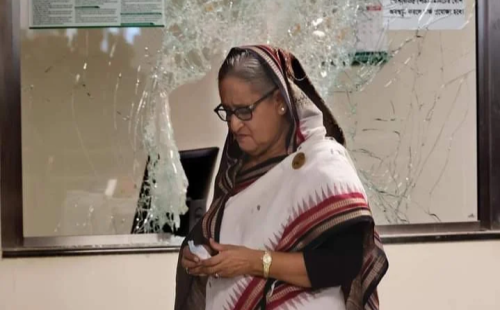
On the 25 July morning, Sheikh Hasina travelled to the Mirpur-10 metro rail
station, vandalised a few days back, to inspect the wreckage of its ticket
machines and signalling systems. Officials from the Dhaka Mass Transit Company
briefed her on the damage; an inquiry committee, formed three days earlier, had
10 working days to assess when services could resume.
Standing
amid the wreckage, Hasina frowned, then began wiping her eyes with a tissue.
"What
kind of mentality drives them to destroy structures that make people's lives
easier?" she asked. "Dhaka city was plagued by traffic jams. The
metro rail provided relief. I cannot accept the destruction of this transport
system."
She
said she wanted justice for the machine. "The people must judge the
perpetrators themselves," she said. "I am seeking justice from
them."
Awami
League General Secretary Obaidul Quader added that the prime minister would
personally bear the cost of treating the injured and supporting the families of
the dead. It was a promise made the same afternoon a nation was tallying its
funerals.
The students would not stand down. Their 48-hour
ultimatum regarding internet restoration and lifting the curfew expired without
a new programme announced, but plans were already forming for Friday: prayers
and mourning processions at mosques and temples nationwide and medical teams to
help the roughly 15,000 injured protesters still needing care.
Crocodile tears
The
country did not take it well.
"We
lost hundreds of students. But Prime Minister Sheikh Hasina had time to cry for
the metro rail, not for the people who will never return," one user wrote
on X, in a post that spread quickly.
"While
others are dying, a railway line is crying crocodile tears," read another.
Journalist
Zulkarnian Saer put it plainly. Hasina had found time to visit a vandalised
station, he said, but none to meet the families of the students shot dead in
the streets.
"She
definitely went there to get some attention and sympathy," a Facebook user
wrote. Online, the phrase "crocodile tears" would outlive almost
everything else said that week.
Memes
and troll posts flooded Facebook. Graffiti appeared with the tagline "Natok
kom koro, pio" (Curb
the drama, dear).
The count that would not stop
climbing
At
Dhaka Medical College Hospital, two more names were added to the register that
day. Zaman Mia, a 19-year-old garment worker from Narsingdi, and Zakir Hossain,
a 29-year-old tailor's shop employee from Rayerbagh. Both died of gunshot
wounds.
Their
deaths pushed the official toll, counted from 16 July onwards, past 156,
including three members of the police. Independent tallies published the same
week already put the real number closer to 203. Amnesty International released
a report that day accusing police of using lethal weapons against
demonstrators.
At
the Dhaka Medical College morgue, 85 bodies had by then been identified and
returned to families for burial. Eight more, still unclaimed, were handed to
the volunteer organisation Anjuman Mufidul Islam so that they, too, could be
buried.
Behind the blackout
The
internet stayed largely dark. Days earlier, the junior ICT minister, Zunaid
Ahmed Palok, had accused Facebook and YouTube of defying Bangladeshi law, the
pretext for a clampdown that kept Facebook, Messenger, WhatsApp and TikTok
offline through the week.
The
curfew, on its sixth day, was relaxed for just seven hours, from 10am to 5pm,
later extended by two more. Soldiers patrolled Dhaka's streets and checkpoints
through the hours in between. Markets and offices came briefly back to life in
the gap, then went quiet again.
Arrests
kept pace with the casualties. Nationwide, nearly 5,000 people had been
detained over nine days — 2,209 of them in Dhaka alone, with hundreds more in
Chattogram, Narsingdi, Sylhet and Barishal. The BNP said its joint secretary
general, Shahiduddin Chowdhury Annie, had been picked up from Elephant Road by
the Detective Branch that afternoon.
The world begins to watch
Volker
Türk, the UN human rights chief, condemned the crackdown and demanded the
government publish, transparently, the names of the dead, the injured and the
detained. The UN, he said, stood ready to help investigate.
BNP
secretary general Mirza Fakhrul Islam Alamgir called for an international
inquiry and compensation for every victim, including protesters, police and
Ansar members. India's foreign ministry said it was watching closely and hoped
peace would return soon. In Washington, the State Department authorised
non-emergency US embassy staff and their families to leave Dhaka voluntarily.
Inside
the country, the students would not stand down. Their 48-hour ultimatum
regarding internet restoration and curfew lifting expired without a new
programme announced, but plans were already forming for Friday: prayers and
mourning processions at mosques and temples nationwide and medical teams to
help the roughly 15,000 injured protesters still needing care.
Ninety-one
students signed a statement calling the government's 23 July gazette only a
partial victory — the fight, they said, was not over until the killers were
tried and the dead were compensated.
By
the time 25 July ended, the country understood exactly what its prime minister
would weep for and what she would not. A nation was burying its dead and
amputating its children's legs. She had wept for concrete and glass. And she
would not go unpunished for it.