'Every moment felt like death was waiting': Bangladeshi sailors return home after 115-day Gulf ordeal
After 115 days trapped near the Strait of Hormuz
amid the Middle East conflict, with missiles overhead and uncertainty shaping
every waking hour, 17 Bangladeshi sailors from the state-owned vessel Banglar
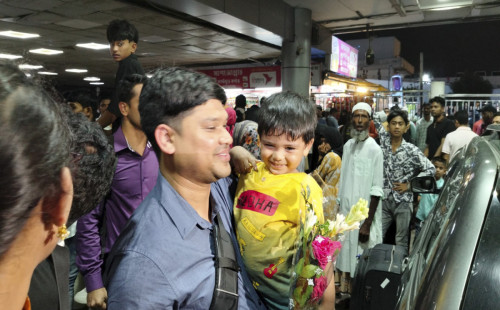
Joyjatra finally stepped onto home soil yesterday (21 July).
The sailors arrived at Hazrat Shahjalal
International Airport in Dhaka at 5:42pm on an Emirates flight from Durban,
South Africa, where they had handed over the vessel to a replacement crew.
For the families waiting at the airport, the
reunion ended months of anxiety as conflict around the Strait of Hormuz left
the crew stranded amid fears of missile attacks and sea mines.
'A missile struck just 200 metres away'
Captain Md Shafiqul Islam Khan, master of
Banglar Joyjatra, said the crew lived with the fear of death every day.
"Hundreds of missiles flew over our vessel.
The fear intensified after a missile struck another ship near us at Jebel Ali
Port. Had it landed just 200 metres closer, our ship could have been hit,"
he told The Business Standard.
Despite the danger, the crew refused to abandon
the vessel.
"We stayed and protected a national
asset," he said.
Repeated attempts to leave the Gulf failed as
authorities denied passage through the Strait of Hormuz because of the deteriorating
security situation.
The breakthrough came only after a ceasefire,
when BSC management decided to move the vessel despite the risk of drifting sea
mines.
Manual navigation through danger
Second Officer Pronoy Krishna Sen described the
passage through the Strait of Hormuz as the most dangerous part of the voyage.
"Drones flew in one direction while
missiles travelled in another. We lived with that reality for 115 days,"
he said.
The crew faced an additional challenge when the
vessel's navigation system malfunctioned during the transit.
"We could not accurately determine our
position, while there was constant fear of Iranian sea mines. If we had struck
one, the vessel could have sunk within minutes."
The crew ultimately relied on manual navigation
to steer the bulk carrier safely through one of the world's busiest and most
strategically sensitive waterways.
"It was one of the most difficult passages
of my career," he said.
BSC provided all-out support
Captain Ziaur Rahman, BSC's general manager for
ship personnel, said the corporation maintained regular contact with the crew
throughout the crisis.
"We arranged high-speed internet so they
could stay in touch with their families, ensured uninterrupted supplies of food
and drinking water, and provided counselling whenever they experienced mental
distress," he said.
He credited BSC Managing Director Commodore
Mahmoodul Malek's decision to sail immediately after hostilities eased with
preventing a much longer ordeal.
"Even a day's delay could have closed the
narrow window for safe passage," he said, adding that more than 1,500
vessels remain stranded in the Gulf because of ongoing security concerns.
The crisis began in late February after Banglar
Joyjatra delivered 39,000 tonnes of steel coils from Qatar's Mesaieed Port to
Jebel Ali in the United Arab Emirates. Escalating tensions in the Middle East
left the vessel stranded in the Persian Gulf with 31 Bangladeshi crew members
on board.
After months of diplomatic efforts and close
monitoring by the government and BSC, the ship crossed the Strait of Hormuz on
23 June before sailing to Fujairah for bunkering and hull cleaning.
It later transported about 37,500 tonnes of
fertiliser to Durban, where the first crew rotation took place.
Seventeen replacement sailors have already
joined the vessel, which is expected to resume commercial operations within
days, with Malaysia likely to be its next destination.