Dhaka-Ashulia expressway cost jumps to Tk27,046cr, deadline pushed to 2030
The government has approved the second revision
of the Dhaka-Ashulia Elevated Expressway project, raising the cost by around
54% and extending the project deadline by four years to June 2030.
The Executive Committee of the National Economic
Council (Ecnec) approved the revised proposal at a meeting held at the Secretariat
today (22 July).
Under the second revision, the project cost has
increased to Tk27,045.67 crore from Tk17,553 crore approved in the first
revision. The latest proposal added Tk9,492 crore to the project cost.
The project initially received approval with an
estimated cost of Tk16,901.32 crore. The latest revision estimates an additional
Tk5,942 crore increase in government funding, marking a 75.59% rise. The
project loan component has also increased by Tk3,550 crore, or 36.63%.
The mega project began in September 2017 with a
completion deadline of June 2022. The first revision extended the deadline
until June 2026. Ecnec has now approved another four-year extension based on
the actual progress of work and required modifications.
Officials from the Planning Commission and the
Bangladesh Bridge Authority said major design changes, additional components,
exchange rate fluctuations and utility relocation requirements led to the
higher cost and extended timeline.
The depreciation of the Bangladeshi taka against
the US dollar played a major role in increasing expenses. The original project
document calculated the exchange rate at Tk80.57 per dollar, which later rose
to Tk86. In the second revision, the rate increased to Tk121.75.
The higher exchange rate increased the remaining
payments to contractors by Tk3,736.61 crore, accounting for around 39.36% of
the total cost increase.
Higher contractor payments also increased VAT
and income tax obligations. The project requires an additional Tk1,000.36
crore, or 10.85% of the total increase, according to Planning Commission
guidelines.
The fall in the value of the taka also raised
the cost of imported construction materials. The project added Tk390.73 crore,
or around 4.12% of the total increase, to cover higher customs duties on
imported materials.
Design changes raise project cost
The revised project includes several engineering
and design changes to improve connectivity, river navigation, and traffic
management.
Following directives from the Bangladesh Inland
Water Transport Authority (BIWTA), the classification of three branches of the
Turag River was upgraded. This required increasing the bridge's vertical
clearance from 7.62 metres to at least 12.2 metres. Engineers also extended
span lengths up to 90 metres, increasing the cost by Tk597.66 crore, or 6.30%.
The expansion plan of the Dhaka-Tongi railway
corridor from two tracks to four tracks, with provisions for six tracks in the
future, required changes to bridge designs. The revised design increased span
lengths up to 125 metres and added Tk153.20 crore, or 1.61%, to the cost.
The project added a trumpet interchange at
Bypail to reduce traffic congestion, costing Tk610.07 crore, or 6.42%. Raising
nearby structures to 18 metres required Tk166.41 crore, while a new ramp
connecting the expressway with the third terminal of Hazrat Shahjalal International
Airport added Tk243.50 crore.
Changes in design, new interchanges and
expansion of toll plaza facilities increased land acquisition requirements from
10.89 hectares to 14.5 hectares. This added Tk747.55 crore, or 7.88%, to the
project cost.
The original project plan did not include
utility relocation and land rental costs. The revised proposal allocated Tk515
crore for shifting electricity, gas and water lines. It also included Tk1 crore
for land rental, bringing the total additional allocation to Tk516 crore, or
5.44% of the cost increase.
Project aims to ease Dhaka traffic
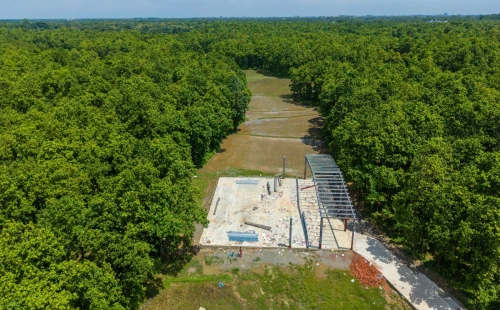
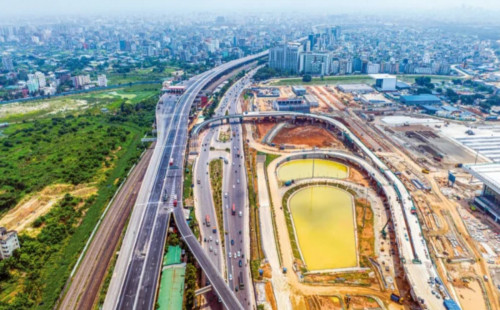
The 24-kilometre Dhaka-Ashulia Elevated
Expressway project starts from Kawla near Hazrat Shahjalal International
Airport and will run through Ashulia to Sreepur in Savar. The Bangladesh Bridge
Authority is implementing the project.
The government launched the project to reduce
traffic congestion in Dhaka and nearby industrial areas and improve transport
links along key economic corridors.
Rapid urbanisation in Dhaka, Savar, and Ashulia,
along with daily commuter pressure, has created severe congestion on the route.
The traffic problems have also delayed the transportation of export goods,
including readymade garments, to Chattogram Port.
The project aims to improve connectivity in
areas with large numbers of garment factories and industries. Heavy traffic
during daily commuting, goods movement and festivals such as Eid has often
delayed the transport of raw materials from Chattogram Port and the delivery of
finished products.
Project history
The project began with a pre-feasibility study
in 2015 for the Abdullahpur-Bypail route. On 22 January 2015, the government
signed a Memorandum of Understanding (MoU) with China National Machinery Import
and Export Corporation (CMC) under a government-to-government arrangement.
Ecnec approved the project on 24 October 2017
with an estimated cost of Tk16,901.32 crore. The government signed the
commercial contract on 29 November 2017. It later signed a loan agreement with
China Exim Bank on 26 October 2021, which became effective on 10 May 2022.
During implementation, China Exim Bank changed
its financing policy and agreed to finance up to 85% of the project cost. The
Bangladesh government had to provide the remaining 15%.
Along with exchange rate changes, the financing
adjustment increased the project cost to Tk17,553.04 crore under the first
revision approved on 1 June 2022.
The Covid-19 pandemic delayed the project's
construction start. After financing arrangements were completed and conditions
improved, construction officially began on 28 October 2022.
The project includes a construction period of
five years and two months, followed by a two-year Defects Liability Period
(DLP).
Second revision approved
Officials said the second revision became
necessary because of design changes, additional works, exchange rate
fluctuations, and land and utility-related challenges.
The revised proposal extends the deadline to 30
June 2030, including the two-year DLP. The total project cost now stands at
Tk27,045.68 crore, around 54% higher than the first revised cost.
The revised proposal was reviewed at a Project
Evaluation Committee (PEC) meeting on 21 January 2026, after which the
Development Project Proposal (DPP) was restructured.