My summer watching the ‘La Pulga’
There is a particular kind of grief reserved for things
that end exactly the way you always knew they would. Not tragedy, tragedy
implies surprise, a fall from some height you didn't see coming. This was
something quieter and, in its way, crueler: the slow, telegraphed closing of a
door you had twenty years to walk through and never quite did. I was a child
the first time I saw him. I was no longer young the last time. Between those
two facts sits my whole life, more or less, measured out not in years but in
tournaments, the way other families measure time in weddings or harvests.
Germany,
2006. A boy with a bowl haircut and knock knees, brought on as a substitute
against Serbia and Montenegro, running with a gait that seemed to apologize for
itself, low to the ground, faintly stumbling, as if gravity had a special, more
insistent claim on him than on other men. Nobody knew yet what they were
looking at. I certainly didn't. I only remember the strangeness of it, the
sense of watching something not yet finished, a sentence without its verb.
Twenty years later I watched that same unfinished sentence reach, at last, its
full stop, at MetLife Stadium, under a sky that could not decide whether to
weep, and understood, with the particular clarity that only endings provide,
that I had spent my entire conscious life as a witness to one man's slow
declension, conjugated every four years in a stadium somewhere in the world.
That
is the peculiar violence of a Messi World Cup. It does not simply mark the
tournament. It marks you, the way a river marks a stone, not all at once, but
by return, by repetition, until the shape of you is no longer entirely your own.
He was never meant to be the story in 2006. A late
substitution, one goal to bury a lifeless scoreline, and then the ignominy of
the bench for the quarter-final against Germany, which Argentina lost on
penalties while he watched from the sideline like a sentence the coach had
decided, wrongly, not to finish. Nobody outside Argentina mourned it. That is
the quiet cruelty of every great love story's beginning: you never recognize
the overture as an overture. You think it is simply weather.
2010 was
Germany again, and worse, 4-0, and Messi reduced to something almost
ornamental, a brilliance with nowhere to spend itself. I remember thinking,
with the specific arrogance only adolescence permits, that international
football was simply too small a vessel for what he carried, the way a teaspoon
cannot hold an ocean, however patiently you pour. Brazil, 2014, came nearer to
correcting me than anything since. He won the Golden Ball that summer and it
felt less like an honor than an apology, a trophy handed to a man for a
tournament he had, by any honest accounting, been robbed of by his own
teammates' feet. Higuain's miss in that final is still, twelve years on, a
wound I can locate exactly, the way you can locate an old scar without looking,
simply by remembering the shape of the injury.
Then
came 2018, and something in me that had been faithful without complaint quietly
stopped being faithful. Croatia, 3-0, and Messi looked, for the first time in
my watching of him, mortal, not merely beaten, but tired in a way that had
nothing to do with his legs and everything to do with the accumulated weight of
a nation's decade of longing, a weight no single man's shoulders were built to
bear indefinitely. I switched the television off before the final whistle. It
was not anger. It was closer to what a mourner feels leaving a hospital room
before the machines are switched off, not wanting to watch the thing you
already know is happening.
Which is precisely why 2022 remains, four years distant
now, the nearest thing to a genuine miracle I have watched with my own
unassisted eyes. Not because Argentina won, though they did, on penalties,
against a rampaging Mbappe hat-trick, against every reasonable law of dramatic
economy, but because I was permitted to witness the exact second a man who had
spent sixteen years pursuing a ghost finally, physically, closed his hand
around it. I watched him lift that trophy and wept without embarrassment,
alone, at four in the morning, because it did not resemble sport in that
instant. It resembled the settling of an old and very patient debt.
He
said that would be his last one. He had said the same in 2018, and it had been
a lie of hope rather than fact. So when he took the field this July,
thirty-nine years old, the first man in the tournament's century-long history
to play in six of them, I promised myself I would watch differently this time,
with less faith and more valediction, the way one watches a long autumn light,
already certain of the dusk, choosing to watch anyway because the watching
itself is the point.
And what a
light it was, before it failed. Eight goals. Four assists. A semi-final against
England in Atlanta I will never adequately explain to anyone who was not awake
to see it, two goals conjured from nothing in the last twenty minutes,
Argentina somehow alive when every reasonable arithmetic said they should not
have been, and Messi at the still center of it, no longer sprinting, barely
walking at times, and yet still finding the half-yard of grass that no other
eye on the pitch could locate. I watched that match standing, unable to sit, the
way I had watched him at nineteen, as though my body still believed, even if my
mind had learned better.
The final against Spain was cruel in the specific,
understated way finals reserve for aging greats, not a single dramatic blow but
a slow strangulation, an entire evening's oxygen quietly withdrawn from the
room. He touched the ball 54 times in 120 minutes. In the fifth minute he found
himself, briefly, alone with the goalkeeper, the one clean sentence in an
otherwise illegible match, and Unai Simon reached it first, and some old,
well-worn part of me already knew the rest before it happened.
Ferran
Torres scored in extra time, and that was that. Spain's second star.
Argentina's dream of consecutive immortality died the way most dreams actually
die: not in one operatic collapse, but in a hundred small withheld chances, stacked
quietly on top of each other until the weight became the outcome.
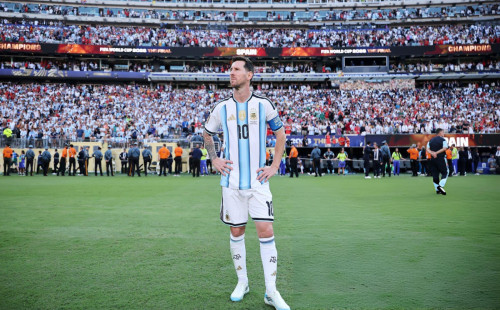
I
watched him afterward, hands on hips, head lowered, and then, unmistakably, in
tears, while Lamine Yamal, nineteen years old, precisely the distance in age
between the boy I met in 2006 and the man I lost in 2026, ran past him toward
the celebration. The torch was not handed over. It was simply, wordlessly,
taken, the way it always eventually is, by someone too young to know yet what
it costs to carry.
I
do not know if I will watch football with the same unguarded devotion again.
Probably I will, that is the nature of fandom, we are incorrigible, we always
find the next altar. But I know this was the last World Cup in which I would
look at a pitch and know, without searching, exactly where to rest my eyes. For
twenty years, whenever I did not know what to do with my attention, I gave it
to him, small, unhurried, faintly bow-legged, doing quietly what no one else on
the field could do even loudly. This was the last time. I am glad, in the end,
simply to have been watching.