Govt sets ambitious post-LDC targets as investment languishes
The government is preparing an ambitious five-year trade
and investment strategy to support a smooth transition from least developed
country (LDC) status, targeting a 75% rise in per capita income to $5,000 by
2031 through higher investment, stronger export competitiveness, and
wide-ranging regulatory reforms.
It also hopes to make significant
progress in reducing economic vulnerability while improving human assets and
social development indicators under the plan.
The targets are outlined in the
Country Programme Document 2026-2031, prepared by the commerce ministry
with financial support from the World Trade Organisation (WTO).
The programme aligns with
the BNP's election manifesto and the "Smooth Transition Strategy"
prepared during the previous Awami League administration.
Under the plan, Bangladesh aims to increase services exports to $10 billion
within five years while expanding the number of exportable products by 60%. It
also seeks to raise export-oriented investment from 0.65% of GDP to 1%.
The strategy comes at a time when
Bangladesh's financial sector remains under pressure, private sector investment
growth is at its lowest level on record, and many businesses are unable to
start production despite making investments because of energy shortages.
The plan also follows decades of
limited progress in export diversification and efforts to improve the
investment climate.
The
Country Programme places strong emphasis on modernisingtrade
infrastructure, attracting FDI and reducing Bangladesh's heavy dependence on
the ready-made garments sector.
Prepared jointly by the Ministry of Commerce and the WTO's Enhanced Integrated
Framework (EIF), the report stresses the need to make the business and
investment environment simpler and more modern, alongside wide-ranging
regulatory reforms.
The programme has
initially identified 52 projects to help achieve its objectives. It also
outlines the expected financial and technical support from development
partners, alongside the respective roles of the government and
business organisations.
Investment constraints
Mahmud Hasan Khan Babu, president
of the Bangladesh Garment Manufacturers and Exporters Association (BGMEA), said
higher public, private and foreign investment would be essential if Bangladesh
was to achieve its 2031 targets.
"Private investment is
currently at its lowest level in history. This is due to the gas and
electricity crisis, infrastructure bottlenecks and high bank lending
rates," he told The Business Standard after reviewing the programme.
"If reliable gas and
electricity supplies cannot be ensured and lending rates are not brought down
to single digits, investment will not increase and these targets will remain
beyond reach."
Implementation key to success
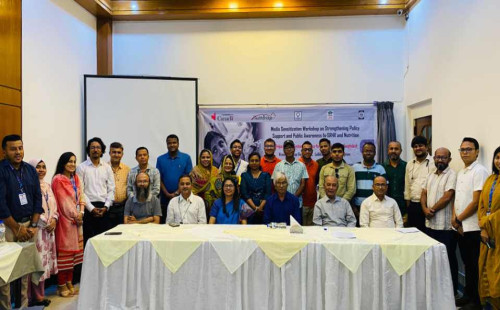
The commerce ministry held a
validation workshop on Sunday to finalise the
five-year programme.
At the event, Commerce Secretary
Md Ataur Rahman Khan said preparing policies and research reports
alone would not be enough, stressing that successful implementation would
determine whether the programme achieved its objectives.
Former additional secretary and EIF
consultant Md HafizurRahman said development partners would provide
financial and technical assistance to support implementation. "If the
government takes the right decisions at the right time and implements them
effectively, achieving these targets will become much easier."
The programme also states
that Bangladesh's progress will be assessed against various international
benchmarks to measure both the implementation of reforms and improvements in
the country's overall capacity.
Preparing for post-LDC challenges
Government reports have warned that
once Bangladesh graduates from LDC status, it will gradually lose duty-free and
quota-free market access, simplified rules of origin and flexibilities under
the WTO's Agreement on Trade-Related Aspects of Intellectual Property Rights
(TRIPS), with potential implications for exports and investment.
Bangladesh is officially set to
graduate from its LDC status on 24 November 2026.
However, citing global economic
uncertainty and persistent structural vulnerabilities, the government has
sought a three-year extension of the preparatory period until 2029. The request
has been endorsed by the UN Committee for Development Policy (CDP) and is
awaiting final approval from the UN General Assembly.
To address the challenges, the
government plans to sign free trade agreements (FTAs) or economic partnership
agreements (EPAs) with nine countries over the next five years.
Bangladesh currently has an EPA
only with Japan. Negotiations are under way with India, China, South Korea,
Singapore, Indonesia, the United Arab Emirates, the European Union and several
other trading partners.
The action plan targets an increase
in per capita income from $2,820 in 2026 to $5,000 by 2031. It also aims to
double services exports from $5 billion to $10 billion.
The document also describes
Bangladesh's services export earnings as disappointing.
"More than 56% contribution in
the GDP is coming from service sectors. But the exports in these sectors are
minimal; they are not more than $7 billion. Product-based export earnings have
limits to be explored," it says.
"Poor logistics efficiency,
inadequate tourism infrastructure and limited strategic foreign investment in
service industries reduce competitiveness. As Bangladesh transitions from LDC
status, the service sector will face stronger international competition, making
regulatory reform, skills upgrading, digital transformation and a long-term
service trade development roadmap critical for sustainable growth," it
adds.
Export diversification, reforms
The programme places
strong emphasis on export diversification, noting that Bangladesh currently
exports around 500 products worth more than $1,000 each. It aims to increase
that number to 800 within five years.
The commerce ministry also plans to
raise export-oriented investment from 0.65% of GDP to 1%.
The report says Bangladesh is
currently utilising only 71% of the trade preferences available to it
as an LDC because of limited export diversification. The government aims to
increase that utilisation rate to 80% over the next five years.
Alongside trade and investment
targets, the programme gives priority to regulatory reforms.
Bangladesh currently scores 25.7 on
the Regulatory Quality Index. The government aims to raise that score to 40
within five years, saying the target is achievable because of strong political
commitment at the highest levels to implement regulatory reforms.
The government also plans to
improve the country's score on the Investment Facilitation Index from 65.6 to
80 over the next five years through its reform agenda.
According to the Global Economic
Diversification Index, Bangladesh scored 95 on the Trade Diversification Index
in 2025. The programme aims to raise that score to 130 by 2031 by
encouraging greater private sector diversification and higher value addition.