Govt to allow pvt sector to build, operate jetties, terminals at seaports
Highlights
- Govt plans to allow private sector jetties and
terminals at seaports.
- Shipping ministry is drafting the Private Jetty and
Terminal Policy-2026.
- Bangladesh handles 93% of foreign trade through
seaports.
- Private firms may build terminals on govt or private
land within port areas.
- Businesses say private participation could improve
efficiency and reduce costs.
- Approved operators must deposit Tk1 crore as security
with the government.
The government is set to allow
the private sector to build, operate and manage jetties and terminals at
seaports. The initiative has been taken to expand trade and commerce, improve
ease of doing business, and attract foreign investment.
To
facilitate this, the shipping ministry is drafting the "Private
Jetty and Terminal Construction, Operation and Management Policy-2026". The policy will be published soon, Shipping
Secretary Md Zakaria told TBS on 10 May.
The draft states that import-export trade centred around
seaports has expanded significantly. Considering future economic growth, more
industries are expected to be set up, which will further increase trade volumes.
As
a result, alongside the government, the private sector may be included in
constructing, operating and managing jetties and terminals to ensure smooth
cargo unloading, loading and other services, it says.
According
to Bangladesh Bank data, Bangladesh exported goods worth $43.96 billion
worldwide in FY2024-25, while imports stood at $64.36 billion during the same
period, with 93% of external trade being handled through seaports.
According
to the shipping ministry, in FY2024-25, ports handled 3 million TEUs of
containers, 105 million tonnes of cargo, and 4,500 ships.
At
times, current port capacity is insufficient to handle containers, cargo and
ships efficiently, leading to congestion, delays in raw material supplies to
factories and export shipments to destinations.
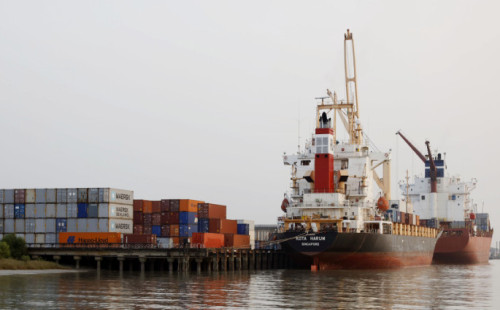
A jetty or berth is a port structure that includes platforms, stages, ramps and
docking points where ships can safely berth for unloading, loading and
transshipment.
Under
the draft policy, private entrepreneurs will be able to establish such jetties
on both government and privately owned land within port boundaries, subject to
approval from the shipping ministry.
Companies
in which the government holds shares will also be allowed to jointly establish
such jetties with private investors.
Selection process must be
transparent
East
Coast Group Chairman Azam J Chowdhury told The Business Standard that the
initiative is undoubtedly positive.
"It
will benefit domestic entrepreneurs. The more terminals there are, the lower
different service charges at ports will become. In most countries, port
operations are managed by the private sector. At the same time, modern
technology will be introduced, making port-related activities easier and
faster," he said.
However,
he added that the process for selecting who will receive responsibility for
building and operating jetties must be transparent.
"If
qualified institutions are not selected, the benefits of this policy will not
be realised. It must be ensured that financially and technically capable
organisations receive the responsibility," he said.
Speaking
to TBS, BGMEA President Mahmud Hasan Khan said including the private sector in
building, operating and managing jetties and terminals would create competition
in service delivery.
"Customers
will go wherever they receive better service. This will create competition
between government and private services, ultimately benefiting users," he
said.
How ports are managed globally
Port
insiders said there are four types of port management systems globally: service
port, tool port, landlord port and pure private port.
The
government plans to allow private sector participation under the landlord port
model.
In
a landlord port, land belongs to the government, while most infrastructure is
built and operated by the private sector. Bangladesh's Laldia Container Terminal
and Patenga Container Terminal fall under this category.
Currently,
Chattogram Port, Mongla Port and Payra Port operate under the tool port model.
In
a tool port, land, infrastructure and equipment belong to the state or port
authority, while private companies use the facilities for cargo loading and
unloading.
A
service port is fully state-owned, including land, infrastructure, equipment
and labour.
A
pure private port is one where everything, including land ownership, belongs to
private entities.
India's
Mundra Port, owned by Adani, is an example of a pure private port. Similar
ports exist in the Philippines, Indonesia, Australia, the UK and Brazil.
The
draft policy also states that private jetties and terminals must use the
relevant port's operational system or an approved automated system.
They
must pay designated fees to port authorities.
For
customs operations, private jetties must provide the necessary infrastructure
for customs officials.
Modern
equipment and technology must be used for cargo loading, unloading and handling
to reduce users' time, cost and physical presence.
Tariffs
or fees for imports, exports and handling at private jetties will be determined
by the port authority.
Private
jetty owners and port authorities will sign separate tariff-sharing agreements
specifying how revenue generated from the jetty or terminal will be divided.
According
to the draft policy, the application fee for setting up such jetties or
terminals will be Tk20 lakh, non-refundable.
Approved
companies will also need to deposit Tk1 crore as security with the government.
Among
the major port users are members of the Bangladesh Garment Manufacturers and
Exporters Association (BGMEA), as more than 80% of the country's exports come
from the ready-made garment sector.
The
sector also imports cotton, yarn, fabrics and other raw materials.
Bangladesh
currently has three seaports – Chattogram, Mongla and Payra. In addition, the
Matarbari Deep Sea Port is under construction and expected to be operational
this year.
Chattogram
Port, with 18 jetties and container terminals, handles around 90% of the
country's trade with the world. It has general cargo berths, container terminals
and the New Mooring Container Terminal.