Govt approves Tk34,347cr Padma Barrage Project
The government has approved the highly discussed Padma
Barrage Project at an estimated cost of Tk34,347 crore.
The approval was granted during a
meeting of the Executive Committee of the National Economic Council (Ecnec)
held at the Secretariat, chaired by Prime Minister Tarique Rahman, today (13
May).
The much-awaited Padma Barrage
Project, which has an estimated price tag of Tk50,443.64 crore, is aimed at
addressing water shortages in the Padma River during the dry season,
revitalising the river system, and improving overall water and environmental
management in the country's south-western region.
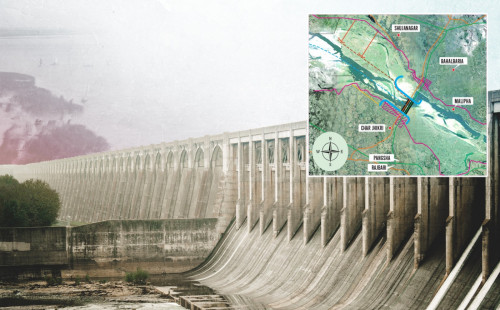
According to project documents, the barrage at Rajbari's
Pangsha will store around 2,900 million cubic metres of water to strengthen
water management in the south-western region.
The project aims to ensure
regulated dry-season flow from January to May in the Ichhamati-Mathabhanga,
Gorai-Madhumati, Chandana-Barasia, Boral, and Ichhamati river systems. It will
also support water supply for the Godagari Pump House, the Ganges-Kobadak
irrigation project, and the Rooppur Nuclear Power Plant.
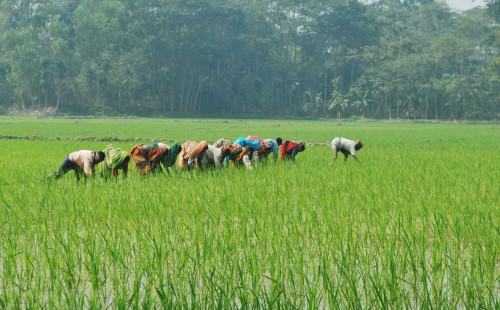
Water supply will be ensured for
around 2.88 million hectares of cultivable land across Kushtia, Faridpur,
Jashore, Khulna, Barishal, Pabna, and Rajshahi.
The project also targets 113MW of
hydropower generation and plans to use the barrage deck as a multi-purpose
corridor for roads, power transmission lines, and gas pipelines.
According to the proposal, the project is expected to result in an annual
increase of 2.39 million tonnes in rice production and 2.34 lakh tonnes in fish
production.
Employment and social impact
During implementation, the project
is expected to generate around 12.25 crore man-days of employment for about
47,950 workers and create approximately 9.27 lakh direct and indirect jobs.
Plans also include seven satellite towns and modern rural townships for around
1.5 lakh families across 3,450 acres.
The feasibility study estimates annual economic returns of around Tk8,000 crore and a 0.45% contribution to GDP growth based on FY25. The project is also expected to reduce salinity intrusion in Satkhira, Khulna, and Bagerhat, helping restore the ecological balance in the Sundarbans and surrounding coastal areas.
Water security and environmental protection
According to Water Development
Board (WDB) officials, the project is not just an infrastructure project; it
could become a central solution for water security, food security, and
environmentally sustainable development in Bangladesh.
"The barrage could improve the
lives of millions of people directly and indirectly, while bringing major
positive changes to agriculture, fisheries, industry, and the
environment," an official added.
Since the construction of the
Farakka Barrage in the 1970s, upstream water diversion has significantly
reduced the natural flow of the Padma River during the dry season. This has
increased salinity intrusion in rivers and canals in the south-western region,
adversely affecting agriculture, fisheries, forestry, and river navigation. It
has also put the biodiversity of the Sundarbans under severe threat.
Strategic response to crisis
The Padma Barrage Project covers
around 37% of Bangladesh's total geographical area, spanning four divisions, 26
districts, and 163 upazilas.
WDB officials noted that dry-season
flow in the Padma-Ganges system was around 70,000 cusecs before the Farakka
Barrage. Since 1975, upstream withdrawal has at times reduced flow to 20,000
cusecs or less. If this situation continues, livelihoods across 20 to 25 Padma-dependent
districts could face severe disruption.
In January, towards the end of the
interim government's tenure, the project was sent to the Planning Commission
for approval after nearly six decades of discussion.
An attempt was also made to place
it before the 25 January Ecnec meeting. However, former planning adviser
Wahiduddin Mahmud said approval should not be rushed, given the project's high
cost.
The total estimated cost stands at
Tk50,443.64 crore. However, the Project Evaluation Committee recommended a
phased implementation, proposing Tk34,497 crore for the first phase. Officials
said completion is tentatively scheduled for June 2033, with full financing
from government resources.
On 6 May, the Planning Commission
and the Ministry of Water Resources briefed the prime minister on the project
and reviewed its key components. The prime minister directed the inclusion of
an assessment of the project's expected GDP contribution in the proposal.
Infrastructure details
The project includes a 2.1km long
main barrage with 78 spillways, 18 undersluices, fish passes, a navigation
lock, and guide embankments. Three offtake structures will be built for the
Gorai, Chandana, and Hisna rivers.
For river management, 135.6km of
dredging will be carried out in the Gorai-Madhumati system, and 246.46km of
re-excavation will be undertaken in the Hisna system.
Officials further mentioned that
the barrage would create a 165km in-stream reservoir without major additional
land acquisition, opening new opportunities for tourism, fisheries, and local
economic activity.
In addition to the 113MW
hydropower, there is further potential for several hundred megawatts through
future solar installations along both riverbanks.
Farakka impact on local rivers
The project proposal states that
water flow in Bangladesh's south-west has fallen sharply since India's Farakka
Barrage began operation. Under the 1996 Ganges Water Sharing Treaty, the two
countries share the river's flow at Farakka from 1 January to 31 May each
year.
The 30-year treaty expires this
year.
The proposal states that upstream
flow reduction from the Farakka has drastically lowered the Padma's flow,
harming agriculture, fisheries, forestry, navigation, water supply, and the
ecosystem.
Reduced freshwater has damaged the
Sundarbans mangrove forest and its biodiversity, and high salinity in nearby
rivers and canals during the dry season has caused severe stress.
Declining flow has led to silt
accumulation in the Hisna-Mathabhanga, Gorai-Madhumati, and Chandana-Barashia
rivers, blocking natural currents. During dry periods, most water flows
directly to the Bay of Bengal, leaving inland rivers nearly dry.
This has increased salinity, river
erosion, siltation, disrupted navigation, and reduced irrigation and fisheries
output. Excessive salinity has also caused widespread "top dying" in
Sundarbans trees.
Feasibility studies
Bangladesh has been exploring the
idea of a Ganges Barrage since the 1960s, with the first study launched in 1961
by the then EPWADA, now the Bangladesh Water Development Board (BWDB).
Between 1960 and 2000, four
pre-feasibility studies were conducted. In 2002, the Water Resources Planning
Organisation recommended that the barrage be built either at Thakurbari in
Kushtia or at Pangsha in Rajbari. Detailed feasibility studies and engineering
designs were later carried out between 2009 and 2016.
Meanwhile, Bangladesh and India
continued technical-level discussions. In October 2016, experts from both
countries conducted joint site visits and meetings in Dhaka, followed by the
creation of a joint technical sub-committee to facilitate data sharing.