Govt undertakes Tk2,028cr railway rehabilitation project to modernise western zone rail network
The government has undertaken a big initiative to
rehabilitate and maintain critical railway infrastructures in Bangladesh
Railway's western zone to ensure safer and faster train movement, improve
passenger and freight services, and strengthen regional rail connectivity.
A project titled "Maintenance
and Rehabilitation of Railway Tracks in the Western Zone of Bangladesh Railway
(1st Phase)" has been undertaken following approval by the Executive Committee
of the National Economic Council (ECNEC) in its last meeting with an estimated
cost of Tk2,028.59 crore, to be entirely financed from the government's own
resources (GoB).
Talking to BSS, a senior official
of the Planning Commission said that the Ministry of Railways will implement
the project through Bangladesh Railway over a five-year period by 28 February
2031.
The official said the project has been designed with three key objectives:
ensuring safe train operations at designated speeds, enhancing the quality of
passenger and freight transport services, and reducing long-term maintenance
costs of railway infrastructure.
"The initiative comes against
the backdrop of growing operational pressure and ageing infrastructure across
the western railway network, which serves as a crucial transport corridor
linking the country's northern and southern regions with the capital,"
added the official.
Talking to BSS, Member (Secretary),
Programming Division of the Planning Commission, SM Shakil Akhter said that
this was a time-befitting initiative from the Ministry of Railways to
modernize, rehabilitate and conduct maintenance of the railway track in the
western zone.
He said since the Bangladesh
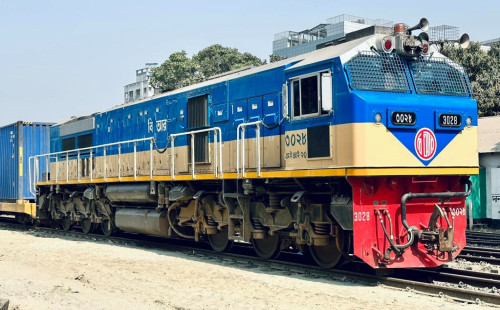
Railway still lacks modern locomotives, coaches and carriages, the Ministry of
Railways has been asked in the last ECNEC meeting to come up with new schemes
to procure locomotives, coaches and carriages to keep pace with the growing
demand.
Bangladesh Railway's western zone currently comprises 1,930.88 route kilometres
of rail line and 2,505.50 track kilometres, handling regular passenger and
freight train movement.
However, many sections of the network were originally built using rails
installed in 1930, 1943, 1968 and 1969, leaving large stretches vulnerable to
deterioration.
The deterioration rate of rails in
several sections has risen to 12–15%, resulting in frequent incidents such as
track cracks, welding joint failures and rail breakages, all of which pose
increasing risks to safe train operations.
The Planning Commission official
said the condition of railway sleepers and ballast has also emerged as a major
concern. Around 25–30% of sleepers in several sections are either damaged or no
longer functional, while shortages of ballast — the crushed stone layer
essential for maintaining track stability and alignment — have weakened track
balance and gauge protection, increasing accident risks.
In some sections, including the
Saidpur–Joydebpur corridor, railway lines rehabilitated with older materials in
the early 2000s are now operating beyond sectional capacity due to increased
train movement.
"As a result, the
effectiveness of rails, sleepers and fittings has declined rapidly, forcing
railway authorities to impose speed restrictions in many areas and adversely
affecting service quality,"
Under the scheme, 21.492 kilometres
of railway track from Bhabanipur to MGMCL will undergo maintenance and
rehabilitation, while 500.2 kilometres of railway lines will receive routine
maintenance works.
Additionally, 43.90 kilometres of
track will undergo full rehabilitation aimed at improving operational
reliability and safety standards.
The first phase will prioritise
railway sections considered strategically important for operational continuity
and freight movement, including Joydebpur–Ibrahimabad, Soydabad–Ishwardi
Bypass, Ishwardi Bypass–Malonchi, Bheramara–Ishwardi Bypass, Malonchi–Sahagola,
Sahagola–Santahar, Santahar–Joypurhat, Joypurhat–Birampur, Birampur–Parbatipur,
Abdulpur–Rajshahi Court, and Bhabanipur–Madhyapara.
The project area spans multiple
districts across Rajshahi, Rangpur and Khulna divisions, including Sirajganj,
Pabna, Rajshahi, Natore, Chapainawabganj, Naogaon, Bogura, Joypurhat, Dinajpur,
Nilphamari and Kushtia.
Beyond domestic transport
improvements, the project is expected to play an important role in
strengthening regional rail connectivity. Bangladesh Railway's western zone
serves as a gateway for freight movement through major land ports such as
Benapole, Darshana, Rohanpur, Birol and Chilahati, which regularly handle heavy
cargo, including stones and boulders.
Officials said successful
implementation of the project would facilitate smoother international
rail-based passenger and freight movement with neighbouring countries,
particularly India, Nepal and Bhutan, while supporting broader regional
integration initiatives.
The project is also expected to
complement regional connectivity frameworks such as the Trans-Asian Railway
Network (TAR), South Asian Association for Regional Cooperation (SAARC),
Bangladesh-China-India-Myanmar (BCIM) Forum, Bay of Bengal Initiative for
Multi-Sectoral Technical and Economic Cooperation (BIMSTEC) and the
Bangladesh-Bhutan-India-Nepal (BBIN) initiative.
A feasibility study for the project
has already been completed by the Infrastructure Investment Facilitation
Company (IIFC).