Floodwaters swallow haor harvest in Sunamganj, leaving farmers counting losses
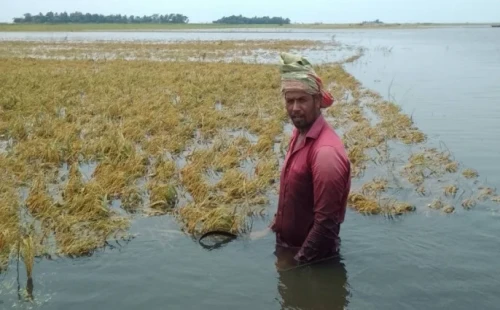
Farmer Jhontu Das of Bhandabil Haor in Shalla upazila of
Sunamganj cultivated paddy on 240 decimals of land. He has managed to harvest
only about half; the rest remains uncut as rising water has submerged his
fields.
"The
haor is now under water. We can't harvest – there are no workers, and machines
can't enter the fields," he said. Jhontu fears the remaining crop may be
lost entirely. "If it stays submerged for a few more days, it will rot. I
won't even recover my production cost. I don't know how I'll survive the year."
While
Jhontu has salvaged part of his harvest, others are worse off. Matin Mia of
nearby Gungiajuri Haor in Nabiganj upazila said flash floods struck just as he
began cutting his crop. "Everything went under water," he said,
adding that he now faces uncertainty over repaying loans and supporting his
family.
Similar distress is unfolding across the haor region in
Sylhet, where farmers depend almost entirely on a single boro crop. With fields
inundated at the peak of harvest season, that lifeline is slipping away.
Sunamganj
– one of the country's largest boro-producing districts – has been hit
particularly hard. Rayhan Uddin, a farmer from Jatgaon village in Shalla, said
more than half of his fields are submerged. "I can't find labourers, and
even the paddy I cut can't be dried because of continuous rain," he said.
Rivers swelling due to rain
Persistent
rainfall and upstream inflows have pushed up river levels, heightening fears of
further flooding.
According to the Bangladesh Water Development Board, water levels in the Surma,
Kushiyara, Piyain and Sari-Goyain rivers have risen at several points in
Sylhet. In Sunamganj, the Surma rose by about 50cm at the Golghor point in the
past 24 hours, though it remains below the danger level. In contrast, the Manu
River in Moulvibazar is flowing 72cm above the danger mark.
Officials
say that while rivers have yet to cross danger levels in most areas, continued
rainfall and upstream flows from India could worsen the situation.
Questions over damage estimates
Official
data from the Department of Agricultural Extension (DAE) shows harvesting in
Sunamganj reached 28.48% on 25 April, 35.24% on 26 April, 41.21% on 27 April,
and 44.50% on 28 April. Farmers and Haor-based organisations, however, say
these figures do not reflect reality, as continuous rain and lightning since 25
April have severely disrupted harvesting.
Mizanur
Rahman, president of the Sunamganj Haor, River and Environment Protection
Movement, said waterlogging began about a month ago and intensified sharply
after heavy rain over the past few days. "Even harvested paddy stacked in
the fields is now under water," he said, adding that both standing and cut
crops are being damaged.
He
questioned the DAE's estimate that 6,606 hectares have been affected, claiming
that at least 30,000 hectares of boro paddy have already been damaged. He also
disputed claims made at a recent disaster management meeting that 50-60% of the
harvest had been completed. "That is far from the reality on the
ground," he said, noting that the movement's Upazilla-based committees
have assessed losses by consulting farmers directly.
Professor
Chittaranjan Talukdar, vice-president of the Haor Protection Movement, echoed
Mizanur's concerns. He said official statistics underestimate the damage,
potentially depriving affected farmers of government support. "There is a
clear mismatch between official reports and the situation in the fields,"
he added.
On
the authenticity of official statistics, Md Omar Faruk, deputy director of the
DAE in Sunamganj, said field officials are collecting data directly from
affected areas. He, however, acknowledged that adverse weather, labour
shortages and the inability to use harvesting machines have slowed harvesting
over the past few days.
Call for urgent assistance
The
upazila agriculture office in Shantiganj has appealed to organisations and
volunteers to help farmers harvest their crops urgently.
In
a statement, the office said haor residents rely heavily on boro cultivation
for their livelihoods. Excessive rainfall has left many fields waterlogged,
delaying harvesting and raising the risk of widespread crop loss.
Political
parties, volunteer groups, educational institutions and local residents have
been urged to step in and assist farmers through coordinated efforts.
Losses spread beyond Sunamganj
In
Kawadighi Haor of Moulvibazar, large swathes of boro fields have also been
submerged due to heavy rain and upstream water.
Farmers
say the situation has shattered their hopes during the harvest season. Many
invested heavily this year in fertiliser, seeds, irrigation and labour, only to
see their crops go under water. With loans to repay, uncertainty looms large.
The
boro crop in Bagerhat has been affected too. Deputy Director of the DAE in the
district Md Motahar Hossain said boro paddy has been cultivated on 68,000
hectares this season, but only 14,000 hectares have been harvested so far. He
added that 8-10% of the crop has already been damaged and warned that losses
will rise if rainfall continues.
In
Cumilla, 1,733 hectares of paddy fields were submerged. Another 550 hectares of
maize,
235
hectares of aush seedbeds, and 364 hectares of summer vegetables were
destroyed, according to agriculture officials.