Seaman and the 42-yard illusion
Distance has always been a sanctuary for goalkeepers.
42 yards!
In football’s unwritten grammar, that stretch is an
impregnable fortress -- a place where a goalkeeper breathes easy. From there,
incoming balls are usually routine, harmless prey waiting to be gathered into
the warmth of the gloves.
But on that sun-drenched day in Shizuoka in 2002, by a
strange whim of nature, that very sanctuary turned into the greatest killing
field of David Seaman’s career. It was as if the wind had secretly conspired
with a Brazilian magician. From Ronaldinho’s right foot sprang an enchanting
mirage that shattered the comfort of distance and, in an instant, turned a
legendary guardian’s lifetime of confidence into an everlasting lament. The
spot Seaman thought was safe; who knew that from there would be written the
opening chapter of the most beautiful yet cruelest tragedy of his life?
2002 World Cup quarterfinal.
Under a blazing sun, two superpowers -- England and Brazil
-- were pushed to the limits of their nerves. It was a clash of two cultures,
two footballing philosophies. On one side, the European reality of discipline,
strength and structure; on the other, the Latin American pulse of rhythm,
imagination and magic. It was a battle of ideologies.
England took the lead in the first half. Michael Owen scored
-- in a flash, with a sharp strike. Brazil’s defence switched off for a moment,
and the ball slipped through into the net. There was resolve in the eyes of the
England players; they seemed to believe they could control the match. But
Brazil are never just a team of plans, they are a team of surprises. And at the
heart of that surprise stood a smiling artist, Ronaldinho.
Late in the first half, Ronaldinho brought Brazil level, not
directly, but through his vision. His pass set up Rivaldo, like the opening
movement of a perfectly composed piece of music. The true symphony, however,
was still to come.
Early in the second half came the moment that would rewrite
history. Brazil won a free-kick from around 42 yards. From such a distance, no
one thinks of shooting. The textbook says to loft it into the box for a header,
or perhaps a deflection. But rules exist to be broken, and Ronaldinho was a
poet of defiance.
The ball lay still. Tension thickened the air. In England’s
goal stood Seaman -- experienced, dependable, calm. A battle-hardened commander
nearing the twilight of his career. He positioned himself slightly forward,
anticipating a cross. His eyes calculated, his mind weighed with experience,
but football does not always obey logic.
Ronaldinho took a few steps back. His gaze was steady, a
mysterious smile on his lips, as if he alone knew what was about to unfold. He
did not charge in like a storm; he advanced slowly, deliberately, like an
artist. Then his right foot kissed the ball.
In that touch, time seemed to pause.
The ball began to rise. Slowly at first, then climbing with
a strange arc, reaching toward the sun. Thousands of eyes in the stadium
followed its path. For a moment, it seemed to be flying too high, destined to
sail over the bar. But then, as if pulled by an invisible force, it dipped.
The ball suddenly bent downward with a perfect, almost
impossible curve.
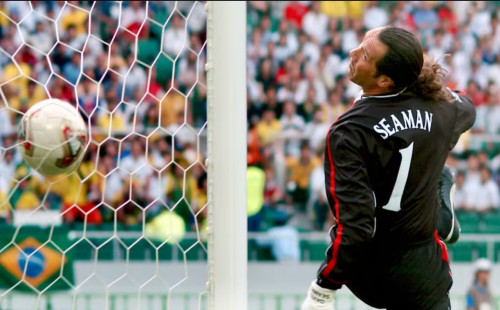
In Seaman’s eyes, a kingdom of astonishment. In a fraction
of a second, he realised the spell he had walked into. There was no time to
reflect on how that Brazilian had read his slight misstep forward. Alarm bells
rang in the mind of the seasoned goalkeeper; a cold surge of panic coursed
through his veins. He scrambled desperately backward. That retreat felt like
the tragic fall of a dethroned emperor. In one final act of despair, he flung
himself into the air, his outstretched arms grasping at emptiness, trying to
halt the inevitable.
For a moment, the stadium fell silent.
Then, an explosion.
Brazilian fans roared in ecstasy, while England’s players
stood frozen.
And Seaman?
With the ball, he too seemed to crash into the net. Trapped
within its cords, he turned to witness the final scene of a tragedy of his own
making. Sitting on the grass, looking back, his face carried a deep wail, a
hollow void, a silent scream. His dazed, grief-stricken gaze seemed to whisper:
“This wasn’t supposed to happen.”
At the other end, Ronaldinho ran with arms outstretched,
that familiar smile on his face, as if he had not scored a goal, but painted a
dream.
The goal still fuels debate. Some say it was deliberate. He
saw Seaman off his line and went for it. Others claim it was a mishit cross,
aided by fortune. The truth perhaps lies somewhere in between, where skill,
imagination and a touch of luck converge.
Brazil won that match. They would go on to lift the World
Cup. But among all the moments of that journey, this one goal shines the
brightest. Because it is not just a scoreline, it is a feeling, a wonder, a
work of art.