Rooftop revolution aligns with Bangladesh's 35,000MW energy vision
Across Dhaka's skyline, once-idle rooftops are
being reborn as power stations, marking a quiet but decisive shift in
Bangladesh's renewable energy journey.
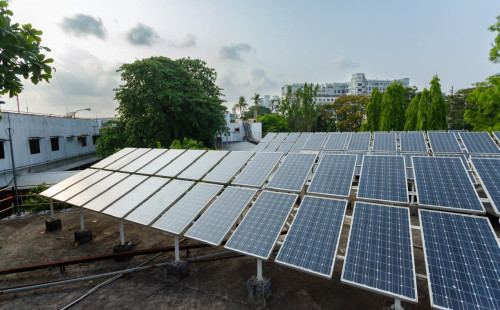
On the rooftop of "Biniyog Bhaban" in
the capital's Agargaon area, a 150 kWp solar photovoltaic installation has
emerged as a showcase of how public institutions and utilities can transform
unused urban space into engines of electricity, revenue, and climate
resilience, according to the Climate Budget Report 2026-27.
The project, implemented under the National
Rooftop Solar Programme, is hosted by the Bangladesh Investment Development
Authority (Bida).
By providing rooftop space while Dhaka Electric
Supply Company Limited (DESCO) undertakes capital investment and operational
responsibilities, the initiative demonstrates how collaboration between public
institutions and utilities can accelerate renewable energy adoption without
imposing heavy upfront costs on government agencies.
The system generates between 500 and 600 units
of electricity daily - around 15,000 units each month while reducing carbon
dioxide emissions by an estimated 150 to 180 tonnes annually, said the report.
Revenue sharing ensures mutual benefit: Bida
receives 10% of the electricity for rooftop usage, while DESCO retains the
remaining 90% along with future carbon credits.
Built with an initial investment of about Tk50
lakh, the facility is expected to recover its costs in just three and a half
years, generating Tk14 to 15 lakh annually.
Such financial viability underscores the
potential of rooftop solar as a scalable solution for Bangladesh's energy
transition.
Beyond economics, the initiative reflects the
country's broader climate and development agenda.
The Climate Budget Report 2026-27 highlighted
the strategic importance of climate-focused investments, with Finance Minister
Amir Khosru Mahmud Chowdhury noting that "Bangladesh stands at a critical
juncture where climate vulnerability intersects with the pursuit of sustainable
and inclusive development."
He added, "In this context, climate finance
is not merely a source of support; it is a key enabler of resilience,
innovation, and sustainable development."
By 2030, the government has set energy targets:
generating 20% of total electricity demand from renewable sources, expanding
overall generation capacity to 35,000MW, and extending transmission lines to
25,000 circuit kilometers.
Longer-term plans envision 30 to 50% renewable
generation by 2050.
Strategic initiatives to reach these goals
include strengthening rooftop and utility-scale solar projects, conducting wind
power assessments in coastal areas, piloting waste-to-energy generation, and
supporting domestic manufacturing of renewable equipment.
The government is also modernizing the grid
through a National Energy Storage Roadmap and offering fiscal incentives such
as a zero percent tax rate on the solar sector until 2035 and a 5% rebate on
consumer solar electricity bills.
Observers note that the panels atop Biniyog
Bhaban symbolize more than a source of electricity.
They represent a practical vision of how
Bangladesh can harness innovation to build a greener future.
As Finance Minister Amir Khosru Mahmud Chowdhury
said in his budget speech, "One of the key objectives of the government is
to address the challenges of climate change and to build a green and
sustainable Bangladesh for future generations."
For a country where climate vulnerability
intersects with the pursuit of inclusive development, rooftop solar is emerging
as a powerful tool. It reduces emissions, generates revenue, and strengthens
resilience, all while making productive use of space that once stood idle.
As Bangladesh intensifies its renewable energy
drive, the rooftop revolution is poised to play a defining role.
Each panel installed is not just a step toward
cleaner electricity, but a symbol of national determination to power growth
sustainably and secure a brighter future for future generations.