‘Ziaul Ahsan orchestrated killings of over 150 people’: Army warrant officer testifies before ICT
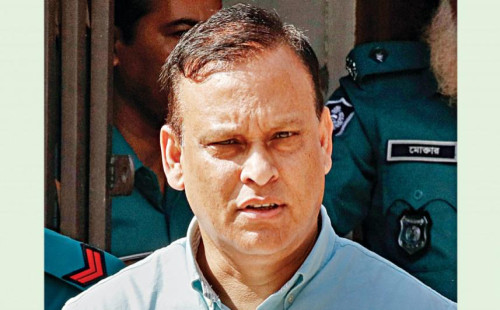
A Bangladesh Army warrant officer, who once served as
the bodyguard of Maj Gen (relieved) Ziaul Ahsan, told the International Crimes
Tribunal-1 yesterday that he witnessed the former Rab intelligence chief
orchestrating and carrying out the killings of 150 to 200 people during the
period he worked under him.
Testifying in a case against Ziaul, Imrul Kayes
narrated before the tribunal several incidents in which he accompanied Ziaul.
He added that Ziaul carried out some operations without his presence.
The earliest incident took place about three weeks
after he began working as Ziaul’s bodyguard, the witness testified. He said he
received a midnight call instructing him to report in front of Rab-1
headquarters, where two black Toyota HiAce microbuses were waiting.
Ziaul, then Rab-1 commanding officer Rashed, and
Captain Kawsar were inside one vehicle.
Ziaul told him that a “sack” in the vehicle’s trunk
needed to be disposed of, the witness said.
The convoy then drove through Tongi and stopped near a
level crossing surrounded by trees and bushes. “When I put my hand in to remove
the sack, I noticed that it was not a sack but a body, and it was cold,” Imrul
testified.
Shaken, he said they carried the body beside the
railway track, after which Ziaul and others placed it directly on the line. A
train soon passed over it.
“I was not myself for five to seven days … I could not
eat properly.”
Imrul is the fifth prosecution witness in the case
against Ziaul, who stands accused of orchestrating the enforced disappearance
and murder of 104 people between 2010 and 2013.
While Imrul was giving his deposition, Ziaul, who was
in the dock, smiled at times. He stood up once and told the tribunal that the
chief prosecutor was encouraging the witness and requested that the witness be
allowed to give his natural statement, otherwise it would be an injustice to
him. The tribunal asked him to speak through his lawyer.
Imrul said he served as the former Rab Intelligence
Wing chief’s bodyguard for about one year and four months between 2010 and
2012.
He said he accompanied Ziaul to numerous locations,
including military and intelligence offices, government establishments, and the
residences of influential individuals.
He claimed Ziaul maintained close ties with then prime
minister Sheikh Hasina’s security adviser Maj Gen (retired) Tarique Ahmed
Siddique and frequented the residences of senior Awami League leaders.
Imrul also referred to events surrounding the
disappearance of BNP leader Ilias Ali in April 2012.
He testified that on April 13 that year, he travelled
in a microbus with Ziaul, Major Naushad and Squadron Leader Saif near Mohakhali
Flyover while waiting for a “target” whose arrival they were monitoring via
phone calls.
The operation was eventually called off and Imrul went
on leave the next day.
While on leave, he learned through media reports that
Ilias Ali had disappeared from the Mohakhali area. Upon returning to duty on
April 23, he noticed what he described as a tense atmosphere at Rab
headquarters.
According to his testimony, fellow personnel told him
that Ziaul had destroyed armoury records and CCTV footage.
ICT Chief Prosecutor Aminul Islam later clarified to
the media that Ziaul did so to erase evidence as Ilias Ali was taken inside the
Rab headquarters and later taken out of there.
Irmul further claimed that during a phone conversation
he overheard, Ziaul told Tarique Siddique, “Sir, as per your instructions, I
have done ‘golf’ with Ilias.”
The chief prosecutor later said that “golf” meant
dumping Ilias Ali.
The witness said he did not know the full context of
the conversation but heard Ziaul complain about his situation and suggest that
he would rather be transferred to a remote place.
While describing another incident, the witness said he
went on to the Sundarbans with Ziaul several times. He said in one such visit
with Ziaul and Rab-8, he heard gunfire after their boat stopped.
“Ziaul sir, then Rab ADG Ops Mujib sir, Commander
Sohail sir, and members of media were present. We proceeded further into the
forest and saw two-three bodies lying there with gunshot wounds. This operation
appeared to me to be a staged operation,” he added.
Imrul went on to describe another alleged killing
involving two detainees taken from a Rab-4 safe house.
After travelling for about half an hour, the vehicles
stopped at a location he identified as “Tin Matha Mor”.
There, he said, one of the detainees was taken out of
a vehicle. The man’s hands and eyes were tied with a towel.
According to Imrul, Ziaul pointed a pistol at the
detainee’s head and shot him dead.
The witness claimed that the victim’s hair caught fire
after the gunshot and that those present laughed. He said they were later
instructed to remove the towel.
A week or two later, he said, he was ordered to board
another microbus carrying two detainees. The vehicle travelled through Tongi
before stopping on the Kanchpur Bridge.
Imrul testified that he watched Ziaul take one
detainee from the vehicle and shoot him twice in the head before dumping the
body into the river below.
He also alleged that Major Naushad carried out the
killing of the second detainee in the same manner.
The witness also described several trips to Barishal
with Ziaul and members of Rab-8.
According to his testimony, detainees were taken by
boat from the Char Duani Bazar area of Patharghata into the Baleshwar river
near its estuary.
“There were times when two people were killed,
sometimes three, sometimes four,” Imrul said.
He alleged that the victims were shot, cement sacks
were tied to their bodies, and they were thrown into the river. Before the
bodies were disposed of, he claimed, their stomachs were cut open with a
commando knife.
Imrul further testified that detainees brought from
Rab-1’s TFI cell were killed using various methods, including gunshots and
injections.
Referring to the nationwide “Operation Rebel Hunt”
launched after the 2009 BDR mutiny, he alleged that Ziaul told him eight to 10
fugitive BDR members had been killed because they had murdered army officers.
According to the witness, some victims were allegedly killed by injection,
while others were shot in the head and dumped into rivers.
Apart from the incidents he described in detail, he
alleged that another 10 to 12 people were killed through injections
administered either inside the TFI cell or inside vehicles.
At the end of his testimony, the serving warrant
officer appealed for his protection.