Shell firms and loans: That's how S Alam bought Islami Bank shares
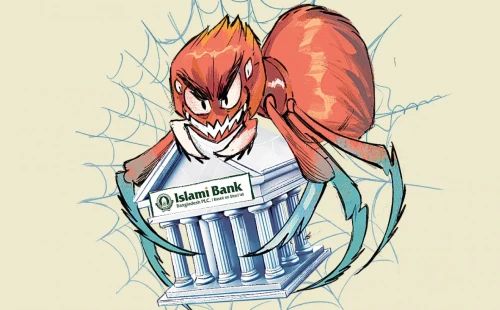
S Alam Group did not buy Islami Bank. It used
the bank's own money to take it over.
That is the central finding of a Bangladesh
Financial Intelligence Unit (BFIU) probe report: the conglomerate that seized
control of Bangladesh's largest Shariah-based bank did so largely through
borrowed funds, much of it channelled from Islami Bank itself and other
financial institutions the group had already captured.
The mechanics were straightforward. A network of
paper companies secured massive loans, generating the financial firepower
needed to accumulate 72% shares and consolidate control.
Once control was established, the pipeline ran
in reverse – the group's ownership of the bank became the instrument for deeper
and larger borrowing, extending the group's reach further into the financial
system.
What the BFIU report describes is not merely a
corporate takeover. It is a case study in regulatory capture: a business group
that used the banking system's own capital to buy a bank, then used that bank
to fund its further expansion, while the central bank and the Bangladesh
Securities and Exchange Commission watched or looked away.
The BFIU probe found that between 2016 and 2017,
the Chattogram-based conglomerate gradually accumulated 72% of Islami Bank's
shares through 22 proxy shareholders and alleged shell companies.
A substantial portion of the funds used for the
acquisitions was routed through accounts of various S Alam Group affiliates and
financed by loans obtained from Islami Bank itself.
The BFIU also found direct involvement of the
company secretary of an S Alam Group firm in one of the transactions involving
two foreign companies that acquired shares in the bank.
Based on these findings, BFIU suspects that S
Alam may have been linked to the share acquisitions made through the foreign
entities as well. If confirmed, the group's effective ownership could rise to
as much as 81.92%. The BFIU has therefore recommended a more extensive
investigation to establish the full extent of S Alam's involvement.
The High Court has already issued a rule,
questioning how the 24 entities' – including two foreign firms – combined
81.92% stake could be considered lawful and why the shares should not be
confiscated.
It has also ordered attachment of dividends on
the disputed shares, suspension of voting rights, and the freezing of bank
accounts belonging to the directors of the entities involved.
In its 28 October 2025 report to the High Court,
the BFIU said its findings were based on documents and data related to share
acquisitions from former Islami Bank board members.
The materials included deposit and loan account
records, vouchers, approval letters, and other relevant data stored in the core
banking systems of Islami Bank, First Security Islami Bank, Global Islami Bank
(formerly NRB Global Bank), Union Bank, First Security Capital and Investment,
Merchant Securities, New Era Securities, and several other financial
institutions.
The BFIU said it had analysed these records
relating to share acquisitions by former Islami Bank board members. "Upon
analysis, it has been observed that 72.07% of the bank's shares are linked to
accounts of individuals and entities associated with the S Alam Group."
Acquisition through seven initial companies
In the early phase, the report identified seven
entities used to consolidate Islami Bank shares – all linked to the S Alam
Group.
Paradise International alone purchased 2.23 lakh
shares worth Tk71.33 crore. According to the probe, the funds were initially
routed through the First Security Islami Bank account of S Alam Group's sister
concern, S Alam Super Edible Oil.
Part of the financing was also arranged through
loans routed via multiple entities, including Momentum Business Center, Epic
Able Traders, Invention Trade International, Abdul Awal & Sons (Patiya),
Nabir Trading and Existence Trade Agency.
These entities held accounts in banks and
Chattogram branches under S Alam Group influence and were identified as
affiliated or fictitious. Paradise International vice chairman and nominated
director Tanvir Ahmed is identified as S Alam's nephew.
In another case, First Security Capital and
Investment acquired 6.43 crore shares through Excel Dyeing and Printing. Funds
were routed through Sonali Traders, S Alam Super Edible Oil and S Alam Refined
Sugar Industries.
Excel Dyeing directors Badrunnesa and Wahidul
Alam are identified as close relatives of S Alam. Several of the financing
entities were also among Islami Bank's top defaulters, indicating use of bank
credit to acquire ownership in the same bank.
Armada Spinning Mills acquired 3.37 crore shares
through First Security Capital. Funds were routed through S Alam Super Edible
Oil, S Alam Vegetable Oil and S Alam Refined Sugar, along with loans from Green
Expose Traders, identified by BFIU as a fictitious S Alam-linked entity. Its
director Jesmin Arshad is the wife of Md Arshad, S Alam's brother-in-law.
Grand Business acquired 3.25 crore shares
through Unicap Securities in 2017, with funds routed via S Alam Refined Sugar
Industries. ABC Ventures acquired 2.23 crore shares through First Security
Capital, financed via Sonali Traders, also identified as S Alam-linked.
Platinum Endeavours purchased 3.22 crore shares
through First Security Capital. Funds were routed through S Alam Steels, S Alam
Super Edible Oil, Genesis Textiles Accessories and Apparels, S Alam Properties
and S Alam and Company.
A portion also came from Paradise
International's BO account, described by BFIU as a shell entity. Its director
Mostan Billah Adil is identified as S Alam's nephew.
Blue International acquired 3.23 crore shares
through First Security Capital and Investment. Funds were routed through Sonali
Traders, Chemon Ispat, S Alam Steels, S Alam and Company, S Alam Properties,
and Genesis Textiles.
Part of the financing is also traced back to
Platinum Endeavours, described as a shell entity. RJSC records show Blue
International managing director Mushfiqur Rahman is a relative of S Alam and an
official of Unitex Group, run by his son-in-law.
Bank loans used to seize control
Investigations indicate that in 2017, S Alam
Group gained control of Islami Bank through a coordinated scheme allegedly
involving an intelligence agency.
The seven entities initially used to acquire
shares were later linked to companies that became some of the bank's largest
defaulting borrowers.
A review of Islami Bank's top 20 defaulters
shows 15 entities linked to S Alam Group. Ownership of these firms extends to S
Alam, his son Ahsanul Alam, son-in-law Belal Ahmed, and other close relatives,
including his brothers.
Bank records show S Alam Super Edible Oil as the
single largest borrower from Islami Bank and its biggest classified loan
account, with defaults of Tk13,040 crore. The same entity also contributed
funds during the 2017 share acquisition.
S Alam Refined Sugar has defaulted loans of
Tk10,281 crore, S Alam Vegetable Oil Tk10,113 crore, Sonali Traders Tk4,853
crore, and Chemon Ispat – named after S Alam's mother Chemon Ara – Tk3,592
crore. Three of these entities were also used in routing funds during the share
acquisition process.
Among the top defaulters is also Infinia CR
Strips, owned by Ahsanul Alam, with defaulted loans of Tk2,777 crore. S Alam
Cold Rolled Steels Tk2,258 crore, Karnaphuli Foods Tk1,783 crore, and Inherent
Trading and Impex Tk1,462 crore, owned by relative Ansarul Alam Chowdhury.
What experts say
Supreme Court senior lawyer Barrister M Abdul
Qaium, representing the petitioner in the Islami Bank share manipulation case,
said the law allows up to 5% ownership without Bangladesh Bank's approval and a
maximum of 10% with approval.
"S Alam Group violated Sections 14 and 15
of the Bank Company Act by acquiring over 72% of the bank's shares," he
said, adding that BFIU findings support the allegations.
Qaium said the High Court has restricted the
sale and transfer of the disputed shares and barred the concerned entities from
the bank's board and a hearing is expected soon.
The lawyer said the petition seeks confiscation
of unlawfully acquired shares, transfer to Bangladesh Bank control, and
recovery of dues through market sale.
Md Abul Kalam, spokesperson for the Bangladesh
Securities and Exchange Commission (BSEC), said monitoring bank shareholding
concentration is primarily the central bank's responsibility, while the BSEC
focuses on disclosure during major acquisitions.
He added that issues involving fund sources and
money laundering fall under the BFIU, and action will be taken if securities
law violations are proven.
Rumee Ali, former deputy governor, said
ownership can be challenged even if shares are not directly held by S Alam,
provided funds are traced to entities under his control.
He said establishing a "fund flow and
control linkage" is essential in court.
Citing international practice, he said courts
can question registered shareholders, and false declarations of beneficial
ownership may constitute perjury with legal consequences.
Islami Bank acting MD Altaf Hossain Khan said a
writ petition challenged the legality of shares held through a single group.
"Following the petition, the High Court ordered an investigation, which he
said has already produced evidence. A hearing is expected soon."
Arif Hossain Khan, Bangladesh Bank spokesperson,
said the matter is under judicial review.
"If the court confirms links between S
Alam, its family members, and bank-financed share purchases, the Bangladesh
Bank will take further action in line with court directives," he said.