Online cattle markets gain popularity ahead of Eid
Highlights:
- Dhaka buyers increasingly purchase sacrificial cattle through online platforms
- Online Qurbani services expanded rapidly following the Covid-19 pandemic
- Buyers prefer convenience, advance booking, and home delivery services
- Rising feed and labour costs are hurting small cattle farmers
- Online livestock sales remain small but steadily growing nationwide
- Authorities urged stricter monitoring against fraudulent cattle fattening practices
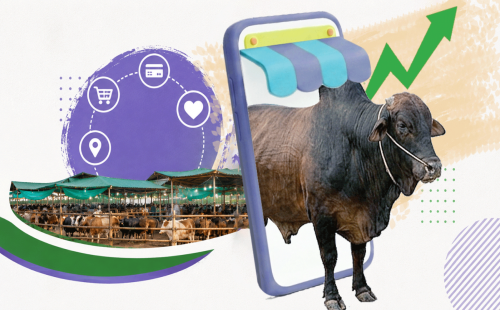
Urban consumers in Dhaka are increasingly turning to online platforms to purchase sacrificial cattle ahead of Eid-ul-Adha, replacing traditional market visits with digital browsing, advance booking and home delivery.
Ziaul Haque, a Mirpur-10 resident, said he stopped visiting cattle markets around 7–8 years ago and now regularly buys from a trusted farm in Bhaluka, Mymensingh. He has already booked a cow for the upcoming Eid.
"Neither I nor my brothers know much about cattle. Buying from the market involves risks, bargaining, and the hassle of transporting and rearing the animal. Now I simply choose from online platform's photos and place an order. They deliver it a day before Eid," he told The Business Standard.
Officials and farm operators say online sacrificial livestock sales have grown steadily since the Covid-19 pandemic, particularly among Dhaka residents seeking convenience.
Buyers now use websites, social media pages and online marketplaces to select animals, book in advance and receive doorstep delivery. Some platforms also offer slaughtering and packaged meat delivery services.
Prices this year for online cattle vary, with native (deshi) cattle quoted at Tk520–610 per kg live weight, while Shahiwal and Friesian cattle are selling at Tk380–450 per kg. Rates are Tk40–60 higher than last year. Cattle are priced at Tk520 per kg for animals under 300 kg, Tk550 for cattle of 300–400 kg, and Tk610 for larger ones.
Online Qurbani services expand
One of the early full-scale digital Qurbani service providers, Bengal Meat, began offering end-to-end online sacrificial livestock booking and meat delivery in 2014. This year, bookings opened on 28 April, with around 500 cattle and 200 goats prepared. So far, about 350 cattle and all goats have been sold.
Shaikh Imran Aziz, head of marketing at Bengal Meat, said most buyers are repeat customers, though new demand is rising, mainly from Dhaka, with additional orders from Chattogram and Sylhet. Customers can choose full animals or share-based Qurbani, with slaughtering and meat delivered to homes.
He added that while Bangladesh's online Qurbani market remains niche, demand is steadily increasing, prompting gradual capacity expansion. Last year, the company handled 400 cattle and 200 goats.
In Pabna's Bhangura upazila, farmer Sagar Ahmed has been selling livestock via gorurhaat.com since 2017. This year, he offered 90 local bulls and eight cross-breed bulls; all local bulls have already been sold.
However, he noted that rising feed and labour costs are squeezing farmers. Feed prices have increased by 25-30%, while cattle prices have not kept pace, making it difficult for small producers to sustain operations.
According to the fisheries and livestock ministry, demand for sacrificial animals this year stands at 10,106,334, against an estimated supply of 12,333,840, including 5,695,878 cattle and buffaloes, 6,632,307 goats and sheep, and 5,655 other animals.
Despite growing digital sales, stakeholders say online transactions still account for a small share of the overall Qurbani market, though improved monitoring and trust-building could significantly expand adoption.
Livestock dept's monitoring urged
Farmers have also raised concerns over fraudulent practices in the sector, including hormone-based fattening and weight manipulation, calling for stronger oversight from the Department of Livestock Services to protect buyers and genuine producers.
Meanwhile, farms are increasingly using platforms such as Bikroy.com for sales. Assurance Farm in Bhaluka, Mymensingh, which also supplies dairy products in Dhaka, entered online cattle trading in 2024.
Rakibul Islam, senior executive (operations), said the farm currently has 250 cattle, with more than 100 already sold. Buyers typically book online and receive delivery on or before Eid, with strong demand from upscale areas including Dhaka's Gulshan, Banani and Baridhara.
He said the farm sold 80 of 100 cattle last year and 53 of 60 the previous year, indicating rising demand.
On livestock health concerns, Md Shahjahan Khan, acting director general of the Department of Livestock Services, rejected allegations of hormone-based fattening, calling such claims scientifically unfounded and unsafe.
He said monitoring teams will be deployed from 23 May, when cattle markets open.