Govt eyes Ganges Treaty renewal with better terms
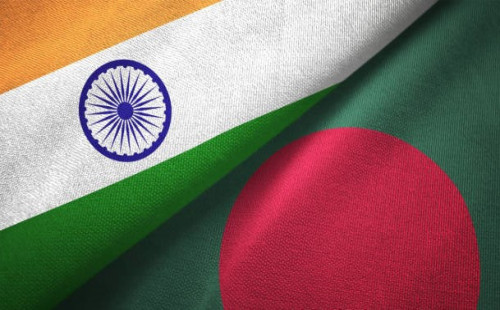
Although the future of the Ganges Water Sharing Treaty will
largely depend on the political relations and mutual understanding between
Dhaka and Delhi, the Joint Rivers Commission, Bangladesh is continuing
preparatory work for a possible renewal.
A senior official at the water
resources ministry said the existing treaty is set to expire in December,
making its renewal a politically sensitive issue between the two countries.
"Ultimately, the shape of the
next agreement will depend on the relationship and understanding between the
two governments," the official said on condition of anonymity.
He added that the ministry and Joint Rivers Commission (JRC) are continuing
routine work, while a process is under way to form an expert-level committee
from both countries.
"Since the current government
took office, only one regular meeting of the JRC has been held, on 8 April in
Dhaka. At that meeting, Bangladesh informed India that it had completed
preparations to form an expert-level committee for the renewal of the
treaty," he said.
He further mentioned that
Bangladesh has already nominated four representatives, and the committee will
be formed once the Indian side completes its preparations. "The joint
expert committee is expected to be formed by mid-June."
Meanwhile, a senior official at the
JRC said the government is seeking improved terms compared to the existing
arrangement, with efforts under way to introduce new elements.
Mahfuzur Rahman, former director general of the Water Development Board, said
no country can unilaterally block the flow of a transboundary river under
international law.
He added, "The United Nations also has established principles aimed at
ensuring equity in the use of transboundary rivers."
"As a result," he said,
"Bangladesh and India are likely to reach an agreement on some form of
water-sharing arrangement."
He further said the proposed Padma
Barrage is crucial for Bangladesh. "If adequate water is not received from
the Ganges for any reason, the barrage could help offset the shortage."
Technical committee working on framework
A Bangladeshi technical committee
is also working on a framework for future water-sharing arrangements, covering
not only the Ganges but also 14 other rivers.
This committee is assessing the
past 30 years of the treaty's impact, changes in the Ganges' flow regime, and
shifts in agriculture and river systems driven by climate change.
Findings from international
agencies are also being reviewed. These assessments will be submitted to the
government and the expert committee to help shape the next framework.
Meanwhile a Bangladeshi team is
currently at Farakka to monitor whether water is being shared under the
existing agreement. A new team is scheduled to visit the site on 20 May, while
an Indian delegation will travel to the Hardinge Bridge point in Bangladesh.
Bangladesh and India share 54
common rivers, but apart from the Ganges, no water-sharing agreement has yet
been signed for any other river. Although long-standing discussions have taken
place on the Teesta, no deal has been reached due to objections from West
Bengal.
Officials said Bangladesh is
expected to formally propose broader water-sharing agreements for 14 rivers,
including the Teesta, Dharla, Dudhkumar, Gomti, Khoai, Manu and Muhuri.
A flashpoint
The Farakka Barrage on the Ganges in
West Bengal's Murshidabad district became operational in 1975 and has since
remained a key issue in Bangladesh-India relations. In Bangladesh, it is widely
linked to river degradation, agricultural stress and flooding.
Following its construction, Maulana
Abdul Hamid Khan Bhasani led a historic Long March towards Farakka on 16 May
1976, a day still observed in Bangladesh.
At an event yesterday, BNP
Secretary General Mirza Fakhrul Islam Alamgir said ties with India would depend
on renewal of the deal, urging a negotiated settlement.
On 13 May, Water Resources Minister
Shahid Uddin Chowdhury Anee said technical teams were working on the matter.
"We expect to review the agreement this year," he said, adding that
India is also engaged and the Joint Rivers Commission is in discussions.
"We hope the 30-year agreement
will continue," he added.
Jamaat-e-Islami Ameer Shafiqur
Rahman welcomed the proposed Padma Barrage but said it cannot replace Teesta
water rights, which must also be ensured.
On 4 May, Indian Foreign Secretary
Vikram Misri met a delegation of Bangladeshi journalists in Delhi and said
Indian experts would take part in the review for renewal of the treaty.
What is in the treaty
The Ganges Water Sharing Treaty was
signed on 12 December 1996 in New Delhi by then Bangladesh prime minister
Sheikh Hasina and her Indian counterpart HD Deve Gowda.
Article 12 states the treaty will
remain valid for 30 years and may be renewed thereafter by mutual consent.
Under the agreement, during the dry season from 1 January to 31 May, the two
countries share the flow of the Ganges at the Farakka point in West
Bengal.
If flow is 70,000 cusecs or less,
both receive a 50% share. If flow is 70,000-75,000 cusecs, Bangladesh receives
up to 36,000 cusecs, with the remainder going to India. Above 75,000 cusecs,
India retains 40,000 cusecs and the rest goes to Bangladesh.
Allocations are calculated on a
10-day basis. The treaty sets guaranteed minimum flows from 11 March to 10 May,
when the two countries alternate 10-day guarantees of 35,000 cusecs.