Agricultural development in the manifesto
Thinking about
agricultural development and implementing it is my profession. The stages of
agricultural progress are designed by aligning the government's vision with the
thoughts of farmers at the field level. Agriculture is now modern and
mechanised, and information technology-based strategies are also being
integrated. Subsistence farming has moved to the background, while commercial
agriculture stands at the forefront.
The concept of
agricultural development differs from development in other sectors. Agriculture
depends on seeds, fertilisers, irrigation, pesticides, and agricultural
machinery. If the demand for these inputs is not properly assessed and timely
supply is not ensured, food security may face setbacks. In Bangladesh,
approximately 6.8–6.9 million metric tons of seven types of fertiliser, 40,832
metric tons of pesticides, and 700,000 tons of seed are required annually. In
addition, one million tons of diesel are used for irrigation. The amount varies
according to the season. Modern agricultural machinery, skilled labourers,
development workers, and extension specialists are also needed. Every year, the
demand for these inputs is increasing. Therefore, to sustain agricultural
development, it is essential to ensure easy and timely availability of these
resources.
I was reading the
current government's agricultural election manifesto. It is excellent and
well-written. At least 12 points in the manifesto comprehensively highlight the
modernisation and commercialisation of the entire agricultural system.
Through my fieldwork, I
see educated young people becoming interested in agriculture-based businesses.
Many are leaving expatriate life to engage in agricultural enterprises. The
nature of agricultural business has also changed. Once, the main business model
was to buy storable products cheaply during the season, store them, and sell
them during the off-season at a higher price. Now this has changed.
The other day, someone
asked me how cucumbers, eggplants, and watermelons flood the market during
Ramadan. I replied that farmers have now become agricultural producers or crop
producers. Before cultivating crops, they first analyse the market. They think
about the timing of production, assess demand, market price, and consumer
acceptance for that period, and then compare production costs with expected
selling prices. This is how marginal farmers engage in agricultural business.
However, there is also
the opposite picture. Some farmers still cultivate seasonal crops without much
planning. Their main concern is the easy availability of agricultural inputs
such as irrigation, fertiliser, and pesticides on time. In such cases, if
environmental conditions are favourable, production increases, prices fall, and
farmers suffer losses.
The current government's
election manifesto reflects a vision for sustainable agricultural development.
It mentions farmer cards, ensuring fair crop prices, and agricultural insurance
for the protection of crop producers. This can encourage farmers to invest more
in agriculture. Previously, they were always anxious about getting fair value
for their produce.
Moreover, farmers in
coastal areas and regions near hilly borders remain worried due to sudden
floods, cyclones, embankment failures, and adverse climate conditions.
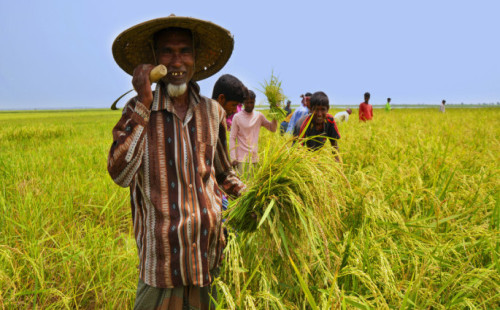
Especially during the rice harvesting season, farmers in the Hakaluki Haor area
fear sudden flooding. Many farmers take short-term agricultural loans, but due
to unfavourable weather and climate risks, they often fail to harvest their
crops. If agricultural insurance is introduced, farmers may have an opportunity
to recover such losses. To reduce farmers' risks from natural disasters,
stabilise agricultural production, and ensure food security, the government is
considering introducing crop insurance even with subsidies. This would help
protect food security. Although there are some risks in launching crop
insurance, many people would welcome such a step in the national interest.
In today's world, every
activity is evaluated in terms of financial profit and loss. Investment decisions
are assessed even more carefully. For a long time, our agriculture was
subsistence-based, where farmers were satisfied if they could somehow survive
and meet family needs. But farmers are now moving beyond that mindset. They
want to treat agriculture as a business and calculate profits and losses.
Educated youth are now investing in agriculture and considering its profitable
aspects.
The government has
emphasised commercial agriculture in its election manifesto. Its plans include
agro-entrepreneurship startup projects and the formation of entrepreneur
platforms. It also includes plans for sustainable agricultural development in
the era of the Fourth Industrial Revolution. This creates opportunities for
young educated people to become agricultural entrepreneurs. Modern technologies
will be used in the fields, enabling the production of quality agricultural
goods at lower cost while making products available to consumers at competitive
prices.
Entrepreneurs will
expand new agricultural businesses through creativity. They will advance
agricultural trade by balancing domestic and international market demand. In
this regard, alongside agro-processing businesses, agriculture-based industries
will expand, creating employment opportunities.
Alongside commercial agriculture,
climate-resilient agriculture is also receiving government attention and
planning. Measures for climate adaptation and addressing adverse climate
impacts are included in government plans.
Overall, the manifesto
speaks of transforming subsistence farming into commercial agriculture,
ensuring farmer protection and food security, and introducing modern
agricultural systems suited to the times. Now it is time for proper planning
and implementation. No matter how good a plan may be, if there are shortcomings
in realistic and proper planning, implementation becomes difficult. Likewise,
even good plans fail due to poor execution. The sooner proper planning and
effective implementation are prioritised based on realities, the sooner the
welfare of the country's agriculture, farmers, and the whole of Bangladesh will
be achieved.
Mohammad Arifur Rahman
is Project Director, Exportable Mango Production Project, Department of
Agricultural Extension.