Extrajudicial killings, custodial torture still stalk Bangladesh
When former prime
minister Sheikh Hasina was deposed in the mass uprising last year, hopes ran
high that the dark days of extrajudicial killings and custodial deaths would
finally be over.
But over the past year, such deaths have continued across Bangladesh, with the
interim government failing to take meaningful action to curb these grave rights
violations.
Human rights campaigners say the
persistence of such deaths and abuses reflects a long-standing culture of
impunity, where those responsible are rarely held accountable.
The death of 30-year-old Hazrat Ali, an expatriate from
Brahmanbaria, serves as a stark reminder of this.
On December 6 last year, Ali was detained during a joint force operation in
Bancharampur upazila. His bruised body was handed over to his family the
following day.
At that time, Morshedul Alam, the then
officer-in-charge of Bancharampur Police Station, could not provide any
explanation. He only said joint forces conducted the drive, and that Ali was
wanted in several robbery cases.
When contacted on Saturday, Pias Basak, additional
superintendent of police of the Nabinagar Circle in Brahmanbaria, said he heard
of the incident but didn't follow up on it.
Another incident involving Md Abdullah from Brahmanbaria's Salimganj union adds
to a troubling pattern of custodial abuse.
Suspected of theft, Abdullah was detained and tortured by locals
on September 23. Later, he was handed over to police. His ordeal continued in
police custody, where he died of his injuries five days later.
Sub-Inspector Md Mohim Uddin was arrested over allegations of
torturing Abdullah in custody.
Human rights activists say his death was one of many cases that
point to systemic failures to prevent custodial torture.
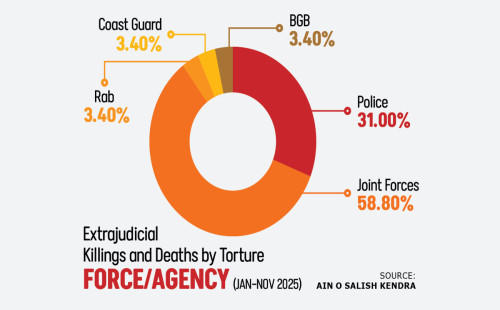
According to data from Ain o Salish Kendra (ASK), 29 people were
killed extrajudicially or died as a result of torture in custody between
January and November this year.
During the same period, 28 convicts and 55 under-trial prisoners
died in jail.
Throughout last year, 20 people fell victim to extrajudicial
killing or faced death in custody while 23 convicts and 42 under-trial
prisoners lost their lives in prison, ASK data shows.
Asked about deaths in prison, Jannat-Ul Forhad, assistant
inspector general of the Prisons Directorate, said 90 prisoners died of illness
over the past 11 months.
He also claimed that no prisoner was
subjected to torture.
When contacted, AHM Sahadat Hossain, assistant inspector general
(AIG) at the police headquarters, claimed deaths by suicide and some incidents
of mob beatings that led to fatalities were shown as custodial deaths in the
reports by rights groups.
"In some cases, individuals were beaten by mobs and left
critically injured. Police rescued them and then took them to hospital where
they died. These incidents were also counted as custodial deaths in the
reports."
He claimed that investigations have been launched into all
allegations of extrajudicial killings or custodial deaths. "Some probes
are complete while others are ongoing."
Citing probe reports on seven custodial deaths, he said two people
were beaten to death by mobs; three died by suicide; and two died of heart
attack.
ACTIVISTS CALL FOR
EFFECTIVE MECHANISM
Human rights advocates have called for independent
investigations into all extrajudicial killings and custodial deaths, along with
stronger oversight mechanisms to ensure accountability within law enforcement
agencies.
Rights activist Nur Khan Liton said the country witnessed
"alarming continuation" of torture and abuses under previous regimes.
"The perpetrators of these crimes remain in positions of
power… No one has been held accountable. There is no sign that justice will be
served."
Liton, also a member of the Commission of Inquiry on Enforced
Disappearances, warned that the entrenched culture of rights abuse and
custodial deaths will continue if the next government fails to act.
Tawohidul Haque, an associate professor at the Institute of
Social Welfare and Research at Dhaka University, pointed out that the lack of
transparency surrounding arrests often fuels suspicion.
"Family members must be informed when someone is detained,
and they must be allowed to verify that the detainee is alive and unharmed.
This will help prevent torture and abuse," he added.