Climate change reducing RMG productivity
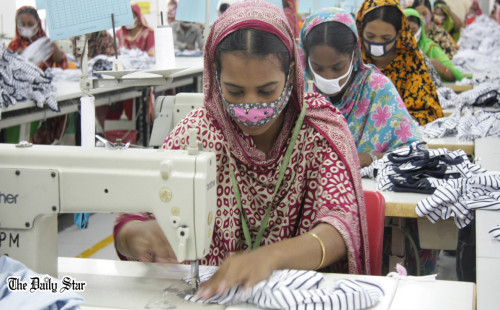
Climate change is
already denting production in Bangladesh's garment factories as rising
temperatures reduce worker productivity, according to a study presented today.
The research, titled
"Global Value Chains and Climate Change Governance: Garment Producers'
Futures", said excessive heat inside factories poses a major barrier to
social upgrading.
Mohammad Harunur
Rashid Bhuyan, senior research fellow at the Bangladesh Institute of
Development Studies (BIDS), carried out the work with Rachel Alexander. He
presented the findings at a session of the Annual BIDS Conference on
Development in Dhaka.
The study noted that
climate refugees are increasingly taking up jobs in the garment sector. As
their numbers rise, more may enter the workforce, which "may have negative
impacts on wages".
Moreover, it said
climate pressures could heighten gender-based violence and harassment as
productivity falls and socio-economic vulnerability increases.
The global garment
industry is a major emitter of greenhouse gases (GHG), releasing between 1.025
billion and 3.29 billion tonnes of CO2e. This represents 2 percent to 7 percent
of total worldwide emissions.
Fossil fuel-based
energy across apparel production stages remains the main source of emissions,
according to the study.
It said fertiliser and
pesticides used in cotton farming and the production of polyester contribute
heavily. During manufacturing, emissions are generated by sewing machines,
production lines, and heating, ventilation and air conditioning systems.
The study said
pressures to cut emissions may support environmental improvements in factories,
although the shift to green energy in Bangladesh remains slow.
The government has
pledged to produce at least 30 percent of electricity from renewable sources by
2041. Yet only 1.4 percent of Bangladesh's electricity in 2019 came from
renewables.
The study said
factories depend almost entirely on the national grid, which needs to be
"green for environmental upgradation of this sector".
The government's
Industry Policy 2022 encourages cleaner industrial practices by promoting
effluent treatment plants, central ETPs, and assistance for industries seeking
to apply clean development management to control greenhouse gases.
Producers, however,
face steep costs, limited access to finance, technical constraints, and
inadequate information and equipment, according to the study.
'UNIONISED WORKERS
EARNING MORE'
A separate study at
the event examined wage patterns among manufacturing workers. Mahmudul Hasan,
research associate at BIDS, said unionised workers consistently earn higher
wages across all model specifications.
The study found that
even after full controls, unionisation remains a strong determinant of
earnings.
For garment workers,
wages are 19 percent to 22 percent higher due to stronger compliance, formal
structures, and higher skill intensity.
The research found no
significant wage difference between unionised and non-unionised garment workers
once characteristics and compliance were taken into account.
Within the RMG sector,
unions advocate for both unionised and non-unionised staff. Spillover effects
and compliance norms help lift garment workers' wages above those in non-RMG
industries.
Unionised RMG workers
earn markedly more than both non-unionised RMG staff and non-unionised workers
in other sectors, the study said.
It added that 11.35
percent of manufacturing workers are unionised overall, earning about 10
percent more than non-unionised workers. Higher wages in RMG may reflect
stronger compliance, more effective unions, formal structures, and greater
skill intensity.
'TECHNOLOGY LIFTING PRODUCTIVITY'
The third study
assessed technology use across industrial sectors.
Kazi Zubair Hossain,
research associate at BIDS, said annual productivity growth in the garment
sector reached 4.19 percent for 2014-2023 due to technological improvements.
RMG firms producing
jackets recorded the fastest growth at 6.59 percent a year. Knit-lingerie
followed at 6.43 percent and sweater production at 6.05 percent.
Home textiles grew by
5.58 percent, and T-shirt production by 4.39 percent. In contrast, woven shirts
rose by 3 percent, woven trousers by 1.15 percent, and denim by 1.81 percent
over the same period, the study said.
BIDS Research Director
Mohammad Yunus moderated the session.