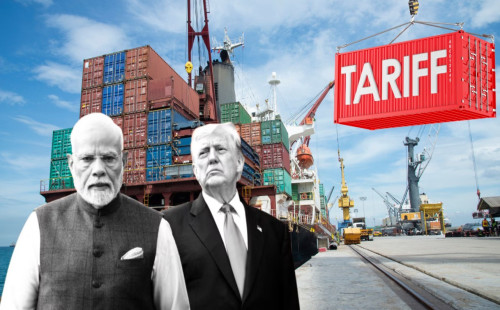
India’s Russian oil gains wiped out by Trump’s tariffs
India saved billions of dollars by stepping up imports of
discounted Russian oil in the wake of the war in Ukraine, but punitive tariffs
imposed by the U.S. that came into effect on Wednesday will quickly
undo the gains, with no easy solutions in sight.
Analysts estimate India has saved at least $17 billion by
increasing oil imports from Russia since early 2022. U.S. President Donald
Trump's decision to impose additional tariffs of up to 50% on Indian imports
could slash exports by more than 40%, or nearly $37 billion, this April-March
fiscal year alone, according to New Delhi think-tank Global Trade Research
Initiative (GTRI).
The fallout from the tariffs will be lingering, and could be
politically debilitating for Prime Minister Narendra Modi, with thousands of
jobs at risk in labour-intensive sectors such as textiles, gems, and jewellery.
India's response in the coming weeks could reshape its
decades-old partnership with Russia and recalibrate its increasingly
complex ties with the U.S., a relationship Washington sees as vital to
countering China's growing influence in the Indo-Pacific, analysts said.
"India needs Russia for defence equipment for several more
years, cheap oil when available, geopolitical support in the continental space
and political backing on sensitive matters," said Happymon Jacob, the
founder of Delhi's Council for Strategic and Defence Research. "That makes
Russia an invaluable partner for India."
But he added: "Despite the difficulties between Delhi and
Washington under Trump, the United States continues to be India's most
important strategic partner. India simply doesn't have the luxury of choosing
one over the other, at least not yet."
Two Indian government sources said New Delhi wants to repair
ties with Washington and is open to increasing purchases of U.S. energy but is
reluctant to fully halt Russian oil imports. Discussions with the U.S. are
ongoing, India's foreign secretary told reporters on Tuesday, with officials
from both countries holding virtual talks on trade, energy security including
nuclear cooperation, and critical minerals exploration.
CRUDE AT $200/BBL?
Russian crude now accounts for nearly 40% of India's total oil
purchases from nearly nothing before the war, and analysts say any immediate
stoppage would not only signal capitulation under pressure but also be
economically unfeasible. Indian purchases are led by billionaire Mukesh
Ambani's Reliance Industries (RELI.NS), opens new tab, which operates the
world's largest refining complex in Modi's home state of Gujarat.
Global crude prices could more than triple to around $200 a
barrel if India, the world's third-largest oil consumer and importer, stops
buying oil from Russia, according to internal Indian government estimates
reviewed by Reuters. It would also lose the up to 7% discount Russian oil
offers compared to global benchmarks.
In an unusually sharp statement this month, India accused the
U.S. of double standards in singling it out for Russian oil imports while
itself continuing to buy Russian uranium hexafluoride, palladium and
fertiliser. New Delhi says other countries that have stepped up purchases of
Russian oil, like China, have not been penalised.
U.S. Treasury Secretary Scott Bessent has accused India
of profiteering from its sharply increased purchases of Russian oil
and called it unacceptable. He told CNBC in an interview last week that unlike
India's surge in Russian oil imports after the start of the war in Ukraine,
China's purchases had increased to 16% from 13%.
India's foreign ministry has said, opens new tab its
crude imports from Russia are "meant to ensure predictable and affordable
energy costs to the Indian consumer. They are a necessity compelled by the
global market situation".
New Delhi warns that halting Russian oil imports, which is
currently around 2 million barrels per day, would disrupt its entire supply
chain and send domestic fuel prices soaring. It has said the previous U.S.
administration under Joe Biden had backed its purchases of Russian oil to keep
global prices stable.
Russia has said it expects India to keep buying oil from
it.
Modi has not directly commented on the tariffs but has
repeatedly pledged support for India's farmers - seen as a veiled response to
Trump's demands to open up India's vast agricultural sector.
Farmers are a key voting bloc, and Modi faces a tough election
in the rural state of Bihar later this year. He has also pledged major cuts in
a goods and services tax by October to lift domestic demand.
TRILATERAL TIES
In a flurry of diplomatic activity aimed at multipolarity,
senior Indian officials have travelled to Russia in recent days, while Modi is
set to visit China this month for the first time in over seven years.
India-China relations began thawing about a year ago, following a deadly border
clash in 2020.
Modi is expected to meet both Chinese President Xi Jinping and
Russian President Vladimir Putin at a summit meeting starting on Sunday of the
Shanghai Cooperation Organisation, a regional security bloc. But the sources
said India is still very cautious in its relations with China and not yet
considering a trilateral summit between the three leaders, as hoped
by Russia.
Other countries could take their cue from how India reacts to
the U.S. tariffs, experts said.
"The key takeaway for other countries is that if India - an
emerging major economic and military power - is under immense pressure from the
U.S., they might have even less capacity to withstand American pressure,"
said Jacob, the analyst.
"Additionally, some might interpret the current dynamics as
indicating that China could potentially serve as a counterbalance, especially
given Trump's unpredictable and aggressive geopolitical moves."
International relations experts say Trump's recent moves have
plunged the U.S.-India relationship back to possibly its worst phase since the
U.S. imposed sanctions on India for nuclear weapons tests in 1998. Besides
trade, the row could affect other areas like work visas for Indian
tech professionals and offshoring of services.
And even if India is able to eventually get some of the tariffs
reversed, several consequences will linger, especially in trade.
"Competitors like China, Vietnam, Mexico, Turkey, and even
Pakistan, Nepal, Guatemala, and Kenya stand to gain, potentially locking India
out of key markets even after tariffs are rolled back," said GTRI founder
Ajay Srivastava, a former Indian trade official.