What is the Mecca Joint Deterrence Agreement between Türkiye, Saudi Arabia and Pakistan?
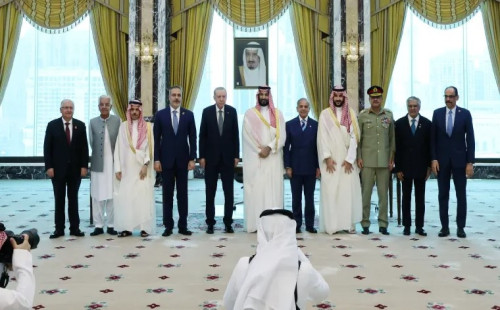
Türkiye, Saudi Arabia and Pakistan signed a landmark
defence agreement in Mecca on Friday, establishing a collective deterrence
framework that says an armed attack against any one of the three countries
would be treated as an attack against all.
The Mecca Joint Deterrence
Agreement, signed by Turkish President Recep Tayyip Erdogan, Saudi Crown Prince
Mohammed bin Salman and Pakistani Prime Minister Shehbaz Sharif, marks a
significant development in the security architecture of the Middle East and
wider Muslim world, says Al Jazeera.
Here is what the agreement means
and why the three countries have signed it.
What does the agreement do?
The pact establishes a collective
defence framework among Türkiye, Saudi Arabia and Pakistan. Under the
agreement, an armed attack against one signatory is considered an attack
against all three.
Beyond mutual deterrence, the agreement
provides for closer military and intelligence cooperation and sets out a
framework for cooperation in energy and defence manufacturing.
The three countries also intend to
build their defence capabilities, including efforts to strengthen Saudi Arabia's
domestic defence industry and reduce its longstanding reliance on imported
weapons.
The Pakistani Ministry of Foreign Affairs said the agreement was "guided
by the longstanding historical ties among the three states, based on the
enduring bonds of brotherhood and Islamic solidarity that unite them, and
building upon their shared strategic interests and longstanding defence
cooperation".
Why was the pact signed now?
The agreement comes as the Middle
East faces heightened instability, including the ongoing US-Israel war on Iran
and the conflict in Gaza.
The regional tensions have also
exposed concerns among some countries about the reliability of existing
security arrangements, many of which have relied heavily on the United States.
Ozgur Unluhisarcikli of the German
Marshall Fund said the agreement "reflects a growing desire for greater
regional strategic autonomy at a time when confidence in the existing security
order has eroded".
Saudi Arabia has faced attacks by
Iran-backed groups, including Yemen's Houthi movement, while Türkiye and
Pakistan have not been directly hit by the recent regional tensions to the same
extent.
Analysts say the three countries
therefore have a shared interest in developing security arrangements that give
them greater capacity to respond independently to regional threats.
"There have been several
layers of necessity converging, and forcing these three big countries to come
together and sign this binding agreement," said Resul Serdar, an Al
Jazeera journalist.
What does each country bring to the partnership?
The three countries have different
military, economic and strategic capabilities that could complement one
another.
Türkiye has one of the region's
most developed defence industries and Nato's second-largest military. Its defence
companies have expanded their production of drones, missiles, naval systems and
other military equipment.
Saudi Arabia brings substantial
financial resources, its position as the world's top oil exporter and
significant political and economic influence in the Middle East.
Pakistan has extensive military
experience and is the only Muslim-majority country with nuclear weapons, giving
the partnership an additional strategic deterrence dimension.
Osama bin Javaid, an Al Jazeera
journalist, said: "The three of them combined now present a force that
will take this region towards a different security architecture than the one in
place over the last few decades".
Why is Saudi defence production important?
A major element of the agreement is
capacity building, particularly the development of Saudi Arabia's domestic
defence industry.
Saudi Arabia has historically
relied heavily on imported military equipment, particularly from the United
States. Building greater domestic production could reduce that dependence while
allowing Riyadh to develop its own industrial and technological capabilities.
Murat Aslan of Hasan Kalyoncu
University said: "We know that Saudi Arabia is dependent on importing
their defence products... especially from the United States for decades, and we
know that it's not cost-effective and they need to build their own defence
sector inside Saudi Arabia".
The agreement provides a potential
framework for Türkiye and Pakistan to contribute to that effort through defence
manufacturing and other forms of industrial cooperation.
Does the agreement target Iran or Israel?
The signatories have presented the
pact as defensive rather than as an alliance aimed at a specific country.
Its timing, however, has prompted
debate over its wider regional implications.
Iranian officials have criticised
the agreement. Ebrahim Rezaei, an Iranian member of parliament, said:
"Saudis must know that a paper agreement with Türkiye and Pakistan will
not bring them security, just as years of one-sided dependence on the Americans
did not bring them security".
Some Israeli commentators have
described the emerging partnership as a "hostile Sunni axis",
reflecting concerns about the creation of a new regional bloc.
Turkish officials, however, have
said the agreement is purely defensive and could be open to participation by
other regional countries.
Erdogan has also strongly
criticised Israel's conduct in the region, saying: "The current
war-addicted Israeli government must not be allowed to drown our geography in
the smell of gunpowder and blood again".
How could it change the regional security system?
The agreement could give the three
countries a mechanism for coordinating their military capabilities and
responding collectively to future threats.
For Saudi Arabia, closer defence
ties with Türkiye and Pakistan could provide additional options beyond its
traditional reliance on US security guarantees.
For Türkiye, the pact could
strengthen its influence in the Gulf and deepen its defence and strategic
relationships with two major Muslim-majority states.
For Pakistan, it offers closer ties
with Saudi Arabia, an important economic and political partner, while expanding
defence cooperation with Türkiye.
Yasmine Farouk of the International
Crisis Group said the closer ties reflect a realisation that "security in
their neighbourhood can no longer be left at the mercy of rivalry between the
US and Israel, on one side, and Iran, on the other".
The agreement does not necessarily
replace existing alliances or security partnerships. But it signals that the
three countries are seeking a greater role in determining the region's security
arrangements rather than relying exclusively on external powers.
What happens next?
The immediate test will be how the
agreement is implemented.
The pact sets out broad areas for
cooperation, including intelligence sharing, defence manufacturing, energy and
military capacity building. Its significance will depend on whether those
commitments develop into sustained institutional cooperation and whether the
collective-deterrence provision is tested by a future crisis.
For now, the agreement represents a
formal attempt by three influential Muslim-majority countries to coordinate
their security policies at a time of heightened regional uncertainty.