NCP unveils Tk 8.52 lakh crore ‘shadow budget’
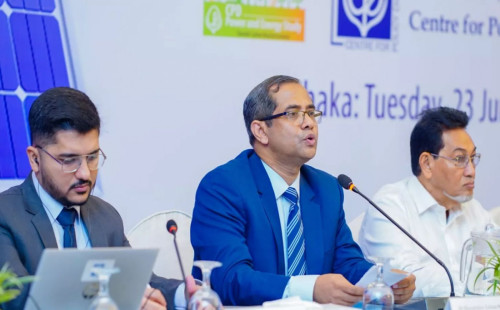
National Citizen Party (NCP) leaders, while unveiling
their shadow budget for the upcoming fiscal year yesterday, said they do not
want rhetoric-heavy, numbers-based, or superficial budgets that exist only on
paper.
“Every single penny allocated must be used for the
public, ensuring that the tangible benefits of the budget reach citizens,” NCP
Chief Organiser (South) and lawmaker Hasnat Abdullah said at the programme in
Banglamotor.
He said the shadow budget, aimed at an equitable and
discrimination-free economy, was prepared after more than two months of
consultations with various stakeholders.
He added that the current government has inherited an
economy in deep crisis from the Awami League, with classified loans exceeding
30 percent of total loans and over $12 billion spent annually on fuel imports.
NCP’s Shadow Budget Committee Chief and lawmaker Atiq
Mujahid presented a Tk 8,52,157 crore shadow budget for FY 2026-27, outlining
an alternative fiscal plan focused on reform, job creation, investment, and
fiscal discipline.
According to the proposal, the Annual Development
Programme would be Tk 2,52,667 crore.
The highest allocation is proposed for education and
technology at Tk 1,24,425 crore. Other allocations include Tk 52,338 crore for
health, Tk 87,567 crore for public administration, and Tk 39,745 crore for
defence. Interest payments are proposed to be reduced to Tk 1,10,450 crore.
The NCP said revenue would be increased mainly by
expanding the tax base rather than raising pressure on lower and middle-income
groups.
The shadow budget also proposes raising the tax-free
income threshold to Tk 4.5 lakh a year. For women and senior citizens, the
threshold would be Tk 4.75 lakh, and for persons with disabilities and
third-gender taxpayers, Tk 5 lakh.
The party also claimed Tk 46,000 crore could be saved
through improved expenditure efficiency, including better ADP project
selection, reduced interest costs, lower subsidy leakage, improved payroll and
procurement efficiency, and reduced operational expenses.
The shadow budget could influence the national budget
if the government aims to make it more inclusive and people-centred, Atiq
Mujahid told the Daily Star.
“If the government has the goodwill and wants to make
the budget inclusive, pro-people, and beneficial for the state, then our shadow
budget can have a major effect,” he said.
He said their proposal contains several “unique”
recommendations that are usually absent from conventional budgets.
He also said the government takes about Tk 1.43 lakh
crore from banks and claimed the proposal shows ways to increase revenue,
reduce interest payments, and lower borrowing costs.
He further said the proposal on electric vehicles
could help reduce fuel costs significantly.
He added that although the budget size is increasing,
its impact remains limited due to inefficient allocation.