Bangladesh 2nd most polluted globally; only 14% of cities meet WHO air quality guideline
Bangladesh ranks as the second most
polluted country in the world, while only 14% of cities globally meet the World
Health Organization's (WHO) air pollution guideline, according to IQAir's 2025
World Air Quality Report.
Pakistan tops the list of the most polluted countries,
followed by Bangladesh, while India ranks sixth, the report said.
The 2025 edition of the report, published by IQAir, a
Swiss air quality technology company, analysed data from 9,446 cities across
143 countries, regions and territories. The data was sourced from more than
40,000 monitoring stations and low-cost sensors operated by government
agencies, universities, non-profit organisations, private entities and citizen
scientists worldwide.
According to the report, only 13 countries or territories met the WHO's annual
average PM2.5 guideline. These include French Polynesia, Puerto Rico, the US
Virgin Islands, Barbados, New Caledonia, Iceland, Bermuda, Reunion, Andorra,
Australia, Grenada, Panama and Estonia.
"130 out of 143 countries or territories (91 per
cent) exceeded the WHO annual average PM2.5 guideline value. The five most
polluted countries were Pakistan, Bangladesh, Tajikistan, Chad and the
Democratic Republic of the Congo. The world's 25 most polluted cities were all
located in India, Pakistan and China, with India home to three of the four most
polluted," the report said.
"This downward trend serves as a stark reminder that
maintaining clean air requires active stewardship and a proactive strategy --
regardless of historical performance," it added.
The report emphasised that maintaining clean air is a
long-term effort rather than a one-time policy achievement.
"For children, however, the impact of air pollution exposure can last a
lifetime; the respiratory damage sustained during developmental years is often
irreversible. As the demographic with the least agency in these environmental
shifts, children are left to bear the permanent health costs of air quality
they did not choose," it noted.
Bangladesh's
pollution crisis
Bangladesh continues to face severe air pollution
challenges, driven by rapid urbanisation, population growth and industrial
expansion. Major cities, particularly Dhaka, remain key contributors to the
country's high pollution levels.
Experts attribute the worsening air quality to a
combination of vehicular emissions, industrial pollution and brick kilns,
alongside high levels of dust.
Older, poorly regulated vehicles running on fossil fuels
emit significant amounts of toxic pollutants, including carbon monoxide,
nitrogen dioxide and sulphur dioxide. Diesel-powered vehicles also release
black carbon and volatile organic compounds, which pose serious health risks.
Brick kilns, widely used across the country, are another
major source of pollution, often burning coal, wood and even waste materials
such as rubber and plastic, releasing harmful substances into the air.
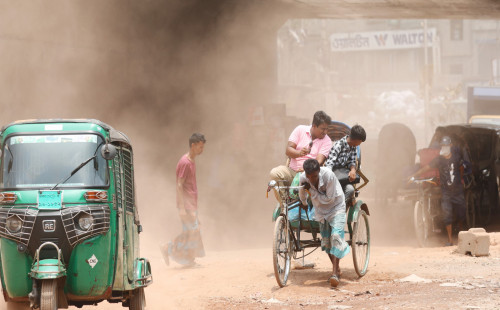
Dust pollution also plays a significant role,
contributing to high concentrations of PM2.5 and PM10 particles.
The report warns that without sustained and coordinated
efforts, Bangladesh's air quality crisis will continue to pose serious risks to
public health and the environment.