Budget to focus on economic stabilisation through reforms, wider tax net: Fin min

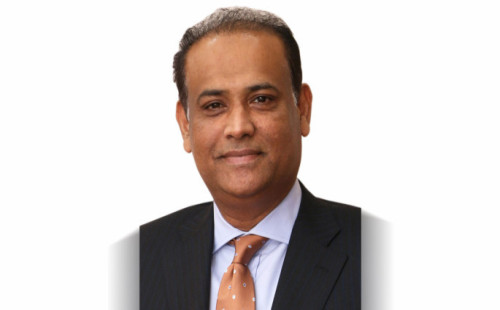
Finance Minister Amir Khosru Mahmud Chowdhury today (21
May) said the government is prioritising economic stabilisation through
structural reforms, expansion of the tax net and restructuring of the financial
sector.
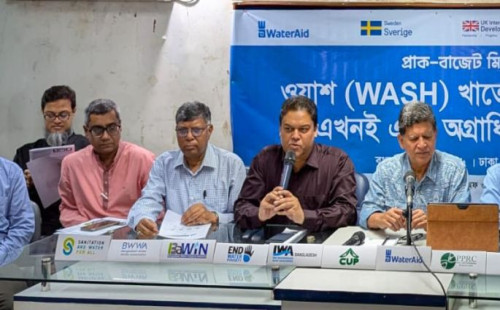
Speaking at a roundtable titled
"Budget in crisis moment and public demand" at Capital Hotel in the
capital, the minister said the government inherited an economy weighed down by
structural weaknesses, underperforming industries and stress in the banking
sector, while recent global geopolitical tensions have added further pressure.
"We are passing through a
challenging period, but this is also an opportunity to bring long-needed
reforms," he said.
The finance minister said many industries in Bangladesh remain undercapitalised
due to prolonged weaknesses in the banking sector and currency depreciation,
which eroded companies' working capital and constrained business expansion,
employment generation and fresh investment.
He said the government is trying to
address these challenges despite limited fiscal capacity and rising external
financing pressure amid the Middle East conflict and higher global interest
rates.
According to the minister, the
global public financing architecture has changed significantly in recent years,
narrowing the gap between concessional and market-based financing as borrowing
costs continue to rise worldwide.
"As financing costs are
increasing globally, Bangladesh now needs financing innovation and a new
financing architecture," he said, adding that such reforms are essential
to achieve the government's long-term target of building a trillion-dollar
economy by 2034.
Highlighting Bangladesh's heavy dependence on the ready-made garment sector, he
stressed the need for export diversification and said the government is
pursuing deregulation and business-friendly reforms to attract both local and
foreign investment.
The minister also underscored the importance of developing the capital market
to reduce excessive dependence on bank financing for large-scale investments.
He said the government is working with global investment banks and
international fund managers, some of whom have expressed interest in launching
Bangladesh-focused funds from financial hubs such as Hong Kong and London.
On revenue mobilisation, the
finance minister said the government is not focusing on increasing tax rates
despite Bangladesh having one of the lowest tax-to-GDP ratios in South Asia.
Instead, it plans to widen the tax net, simplify tax compliance and introduce
technology-driven tax administration.
"We are trying to bring more people into the tax system through
deregulation and ease-of-doing-business reforms," he said, expressing hope
that Bangladesh could gradually raise its tax-to-GDP ratio to 9% if the
National Board of Revenue performs effectively.
The minister also expressed concern
over weaknesses in the country's financial reporting ecosystem, saying poor
accounting standards and lack of transparency have made it difficult for banks,
investors and stock market participants to assess the actual condition of
businesses and financial institutions.
"The financial reporting
ecosystem has weakened significantly, creating another major challenge for the
economy," he said.
He called for coordinated efforts
among the government, businesses and financial institutions to implement
reforms and restore confidence in the economy.